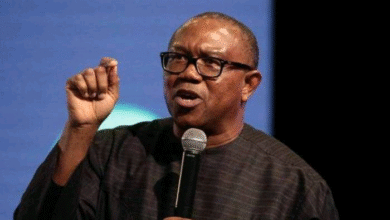
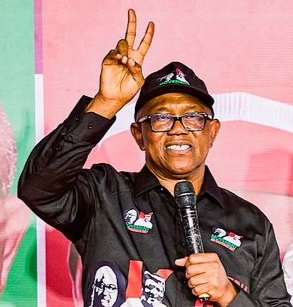
Presidential candidate of the Nigeria Democratic Congress (NDC), Peter Obi, has outlined an agenda focused on security, healthcare, education, agriculture, power supply, employment, and governance reforms after emerging as the party’s flag bearer for the 2027 election.
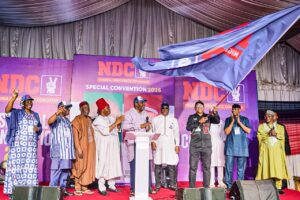
Speaking at the party’s presidential affirmation ceremony in Abuja on Saturday, Obi stated that Nigeria was at a critical crossroads but maintained that “a New Nigeria is Possible.”
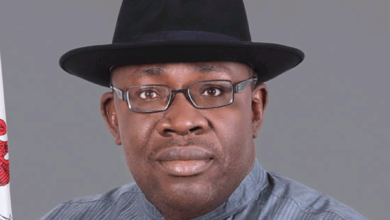
He expressed gratitude to the leadership of the party, including National Leader Senator Seriake Dickson, members of the National Working Committee (NWC), party supporters, and Nigerians who, according to him, have continued to keep hope alive despite the country’s challenges.
“This pivotal moment transcends the individual ambitions of Peter Obi; it concerns the essence of our nation and the future of our children. It is about rekindling hope for millions who have faced adversity yet remain committed to Nigeria,” he said.
Obi identified national unity as a prerequisite for development, stressing that Nigeria could not progress while divided along ethnic, religious, regional, or political lines. “Our diversity should not be a source of division; rather, it is among our greatest strengths. We must heal, unify, and progress together.”
On insecurity, the former Anambra State governor described the situation in Nigeria as worsening and pledged to adopt an intelligence-driven, technology-enhanced, proactive, and community-based security strategy if elected president.
He disclosed that his administration would strengthen security institutions, improve coordination among agencies, support security personnel, and address the root causes of insecurity, including poverty, unemployment, and marginalisation.
“No nation can thrive while its citizens live in trepidation. Farmers must be able to return to their fields securely; students must be able to learn without fear; communities must be able to rest peacefully; and investors must regain their confidence in Nigeria,” he declared.
In the healthcare sector, Obi lamented the poor state of primary healthcare services and low health insurance coverage across the country.
He pledged to increase health insurance coverage from about 10 per cent to more than 20 per cent within four years and raise healthcare spending to at least 10 per cent of the country’s Gross Domestic Product (GDP).
He also promised that every ward in Nigeria would have a functional and properly managed primary healthcare centre within four years, while at least half of the nation’s estimated 30,000 primary healthcare centres would be fully operational by the end of his first term.
Obi noted that education would remain central to his administration’s development strategy, emphasising that no nation could rise above the quality of its educational system.
He promised increased investment in schools, teachers, technology, and vocational training to equip young Nigerians with skills for both employment and entrepreneurship.
Addressing food insecurity, Obi described Nigeria’s hunger situation as unacceptable despite the country’s vast agricultural potential. He argued that transforming agriculture through large-scale investments and shifting the economy from consumption to production would significantly reduce poverty and hunger.
“The uncultivated lands in our northern region represent our most substantial tangible assets. Transforming this sector is our direct pathway to prosperity,” he said.
On power supply, Obi highlighted Nigeria’s electricity deficit, noting that the country currently generates and distributes only about 4,000 megawatts of electricity despite having a population of over 200 million people.
He pledged to increase electricity generation and distribution by at least 10,000 megawatts within four years to stimulate economic growth and industrial development.
The former Labour Party presidential candidate also promised to tackle unemployment and underemployment through targeted support for Micro, Small and Medium Enterprises (MSMEs), including tax incentives, favourable interest rates, and easier access to funding.
He revealed that sectors such as agriculture, manufacturing, entertainment, sports, and distribution would receive special attention to drive job creation.
Regarding governance, Obi pledged to reduce corruption and the cost of governance through transparency, accountability, and prudent management of public resources.
He equally vowed to uphold the rule of law and strengthen democratic institutions by ensuring respect for opposition parties and promoting inclusive governance. “Our democracy will exemplify true governance of the people, by the people, and for the people, completely free from interference by the ruling party,” he remarked.
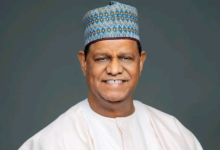
Obi further announced Senator Rabiu Kwankwaso as his running mate for the 2027 presidential election, describing the vice president’s role under his administration as that of a partner in governance rather than a ceremonial office holder.
“I will make democracy work, and the vice president will be a partner, not a spare tyre,” he declared.
He expressed confidence that Nigeria could overcome its challenges through unity, purposeful leadership, and sustained investments in critical sectors.