
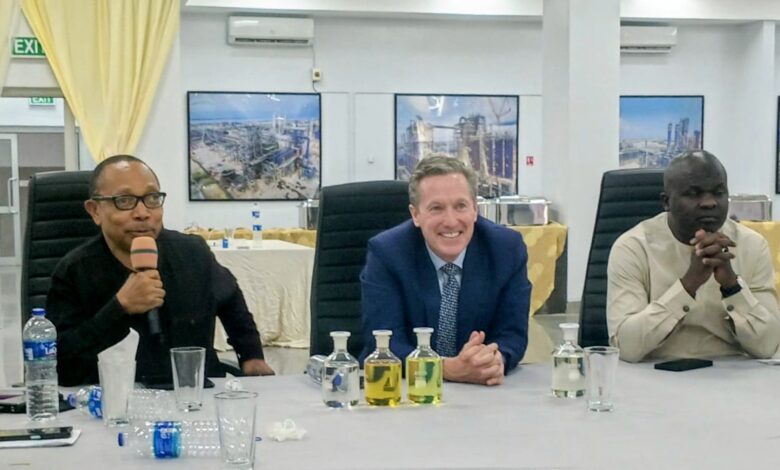
The Chief Executive Officer and Managing Director of Dangote Refinery, David Bird, has clarified the nature of the $20 billion facility, describing it as a merchant refinery heavily dependent on maritime operations, rather than a conventional “tramline” refinery tied to a single crude pipeline.
Bird made the clarification while addressing members of the Maritime Correspondents’ Organisation of Nigeria (MARCON) after a tour of the facility on Tuesday, February 17, 2026, aimed at correcting misconceptions surrounding the refinery’s operating model.
According to him, unlike traditional refineries common in crude-producing nations and parts of the Middle East that process a single crude source, Dangote Refinery operates on a global merchant model similar to those in Rotterdam and Singapore.
In this model, feedstock is sourced from multiple locations worldwide and transported by sea, while finished products are evacuated both domestically and to international markets through maritime channels.
“This is not a refinery just sitting at the end of a crude pipeline. All of our feedstock is imported by sea, and our products can go into Nigeria or out to the global market. That is the standard merchant refinery model”, Bird explained.
He stressed that such refineries are defined more by storage, logistics and maritime infrastructure than by visible refining units, adding that the coastal location and deep-sea access were deliberate design choices to enable efficient import and export operations.
Responding to questions on opportunities for Nigeria’s maritime economy, Bird disclosed that the Dangote Port had already handled about 800 vessels since inception and is projected to receive around 600 vessels annually as operations ramp up. He said the scale of vessel traffic presents significant value-addition prospects in jobs, local content development and logistics growth.
On whether Dangote Industries plans to go fully into shipping, Bird said the company is keen on gaining greater control of its supply chain, noting that it has already progressed from sourcing vessels on the open market to time-chartering ships. He added that outright vessel acquisition is firmly on the agenda once sufficient cash flow is generated.
“It’s a no-brainer to control your supply chain,” he said, citing recent vessel-related disruptions as evidence of the need for deeper involvement in shipping. He also linked the strategy to Dangote’s Pan-African ambitions, including announced plans for a tank farm in Namibia and ongoing engagements in Cameroon and Ghana, to ensure reliable product outlets across the continent.
Earlier, the Head of Marine, Petroleum and Petrochemical, Captain Satendra Singh Rana, provided detailed insight into the facility’s offshore marine infrastructure while speaking to journalists at the landfall point where crude is received and products are exported.
Rana revealed that the refinery operates five Single Point Mooring (SPM) buoys offshore—two dedicated to crude oil and three to refined products, connected by 48-inch pipelines laid two metres beneath the seabed for safety.
He said the crude SPMs can accommodate the world’s largest tankers, including Very Large Crude Carriers (VLCCs) carrying up to two million barrels, with some vessels delivering as much as three million barrels in a single shipment.
He explained that the system is designed for rapid turnaround, with most vessels completed within 24 hours, and larger tankers within 36 hours. According to him, the facility has already handled about 800 tankers, a milestone he described as a game changer for a new refinery-terminal combination.
“With the refinery ramping up to 650,000 barrels per day, we expect about 600 tankers per year, combining crude and products,” Rana said, adding that the offshore design leverages natural water depths of up to 40 metres for crude and 20 metres for products, eliminating the need for costly maintenance dredging.
He further noted that the SPMs and telemetry systems were designed and manufactured by a Houston-based United States company, describing the equipment as among the highest-rated and safest in global maritime energy trade. The absence of severe storms in the region, he added, allows operations to run 365 days a year.
On his part, Victor Ngangha Oyama, an engineer with the Maintenance Planning Department of Dangote Refinery, and one of the tour guides, explained that Dangote Port, formerly a jetty built to receive customised equipment during construction of the refinery, has since been repurposed into a full-fledged import and export hub.
Oyama said the port now handles fertiliser exports to countries such as Brazil and others, receive raw materials, and is slated for further expansion to accommodate more vessels as operations scale up, reinforcing the refinery’s growing footprint in regional and global maritime trade.







A really good blog and me back again.
fqig0l