How Police, NAFDAC Uncovered Lagos Clandestine Hub for Repackaging Banned, Expired Malaria Drugs

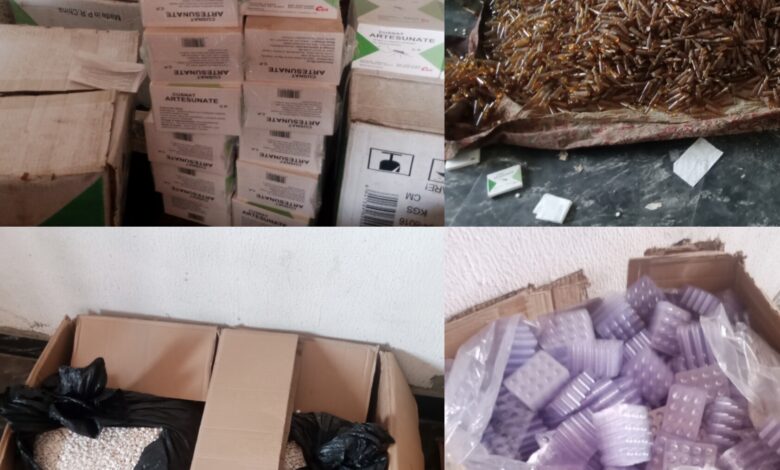
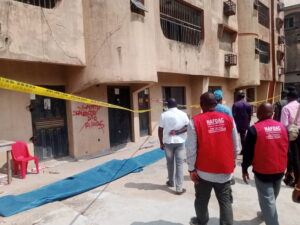
The National Agency for Food and Drug Administration and Control (NAFDAC) in collaboration with the Nigerian Police Force (NPF) has uncovered large quantities of banned and expired malaria medications in an abandoned four-storey building in Ojo Local Government Area of Lagos State.
Director of Investigation and Enforcement at NAFDAC, Dr. Martins Iluyomade, while addressing journalists on Wednesday at the location, described the operation as a grave threat to national security and public health.
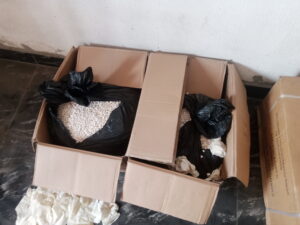
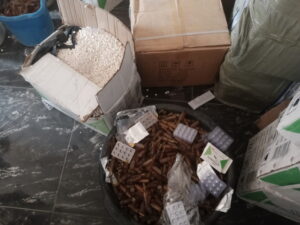
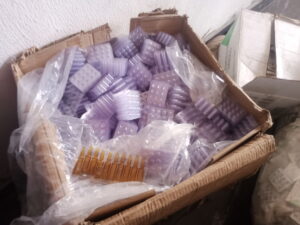
The building, which consists of 15 flats, has been abandoned for over 15 years and was being used as a clandestine hub for the storage, revalidation and repackaging of banned and expired drugs, including artesunate, chloroquine and other sensitive medicines.
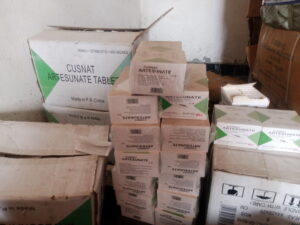
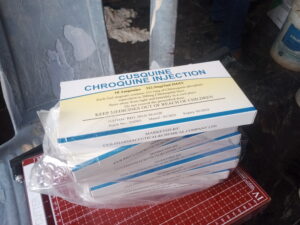
Dr. Iluyomade, who is also Chairman of the Federal Task Force on Counterfeit and Fake Drugs and Unwholesome Processed Foods, explained that monotherapy artesunate is no longer recognised under the World Health Organisation (WHO) malaria treatment guidelines, yet the banned drug was found in large quantities at the site.
His words: “What we have found out is that there are people here who are worse than Boko Haram. These products are already banned. Nigeria has banned artesunate. Worldwide, monotherapy artesunate has been banned for over 10 years because of resistance. But some people are still insisting on selling what is already outlawed.
“Worse still, they will allow it to expire and then revalidate it. Some expired in 2022 and some 2024. So it’s a double-edged sword. It is a banned product and it is expired.
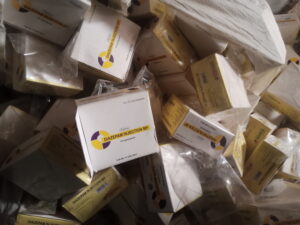
“They have a chemical here that they use to wipe the expiry date. Only God knows the number of people that have fallen victim to this. That is why you see treatment failures, people treating malaria and dying from preventable illnesses.”
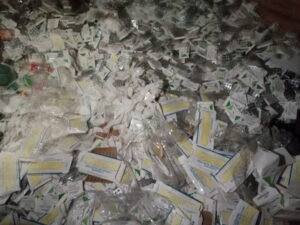
He added that similar practices were observed with chloroquine, another discontinued malaria drug. According to him, investigators also discovered empty drug tablets and packaging materials used to repackage and reseal medicines for resale.
Iluyomade expressed particular concern over the revalidation of highly sensitive medicines, including centrally acting drugs such as diazepam.
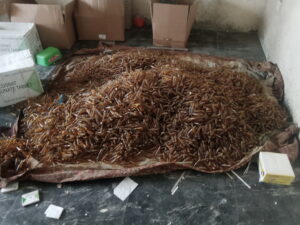
“They will put tablets inside empty cases, seal them and give them to people to use. A bad batch of one medicine can kill more than one million people at a time. This is a serious war. It is a national security issue that we are sleeping on. I don’t really know how to qualify this, but it is wickedness of the highest order.”
Responding to questions on the possibility of capital punishment for those involved in counterfeit drug trade, he said NAFDAC had long been pushing for stricter sanctions.
He recalled a 2008 operation involving fake sedatives traced to China, where the Chinese suspects were sentenced to death in their country, while the Nigerian counterpart served a jail term.
“I wish we had a law like what we have in China — death sentence straight away. Some NGOs say death sentence is not fashionable. But somebody is killing people already. We are going to go back to what we did then, working through Interpol, to ensure Nigeria is not used as a dumping ground,” he said, noting that Chinese authorities do not tolerate such crime.
Iluyomade disclosed that NAFDAC, under its Director-General, Professor Mojisola Adeyeye, has already submitted proposals to the National Assembly seeking a review of existing laws to introduce more severe penalties for counterfeit drug offences.
“As I speak with you, this is before the National Assembly. The process is ongoing, and the agency and the DG are pushing very hard for this.”
He warned that counterfeit and substandard medicines contribute to rising drug resistance and worsening health indices in the country.
“When people use fake medicines, resistance builds up. Then when you use the genuine medicine, it will not work. That is the magnitude of what we are dealing with.”
Speaking earlier, the Divisional Police Officer (DPO), Ojo, CSP Opeifa Omolola, provided insight into how the abandoned building was uncovered, tracing the operation to an earlier interception of expired drugs.
She said the breakthrough followed the arrest of two men in September who were conveying expired pharmaceuticals in a vehicle around the Alaba International Market axis, adding that sustained surveillance and intelligence-gathering eventually led investigators to the location.
“We accosted them and interrogated them, but they did not give us their location or provide any useful information. I had to employ the services of some commercial motorcycle riders (okada) to know exactly where they were operating from”.
According to her, credible intelligence received about three weeks ago enabled the police to identify and access the building, leading to the arrest of another suspect at the scene, bringing the total number of arrests to three.
She added that investigations are still ongoing and the suspects have been handed over to State Security.
On her part, the Chairman of Ojo Local Government Area (LGA),
Princess Muibat Rufai-Adeyemi, attributed the discovery to sustained collaboration between the local government and security agencies, noting they had no prior knowledge of the activities in the building located in a fully occupied residential environment with active community structures.
She expressed concern that despite the presence of community leaders, Community Development Associations (CDAs) and a Community Development Committee (CDC), no formal report was made about suspicious activities in the long-abandoned property.
Rufai-Adeyemi said investigations revealed that people had been frequenting the building, working overnight and leaving in the mornings, with food vendors also serving them, yet the situation went unreported.
Following the discovery, the local government immediately invited the relevant CDA chairmen for questioning, stressing that they had a responsibility to know what was happening within their communities. She emphasised that CDAs are meant to serve as the eyes and ears of government and will now be more actively engaged in monitoring their neighbourhoods to uncover and stop similar activities.
The Chairman pointed out that the local government has intensified efforts to prevent a recurrence by strengthening collaboration with law enforcement agencies and activating a task force to inspect abandoned buildings and locked-up shops across the area.

Speaking further, Dr. Iluyomade stressed that the operation was a collaborative effort involving NAFDAC, the Nigeria Police Force and the LGA.
“This is synergy. We are all working for the same goal. I have to give credit to the Nigerian Police who did a yeoman’s job of discovering this place,” he said, singling out CSP Opeifa for her role in tracking the operation, as well as the Commissioner of Police, Lagos State, for his swift response.
Iluyomade stated that investigation is ongoing and NAFDAC would ensure that all those involved are prosecuted to the full extent of the law.
“We are going to make sure we prosecute whoever is involved. Once we establish that the owner of these banned and expired products is also the owner of this building, we will apply the proceeds-of-crime law to ensure the building is forfeited”, he said.