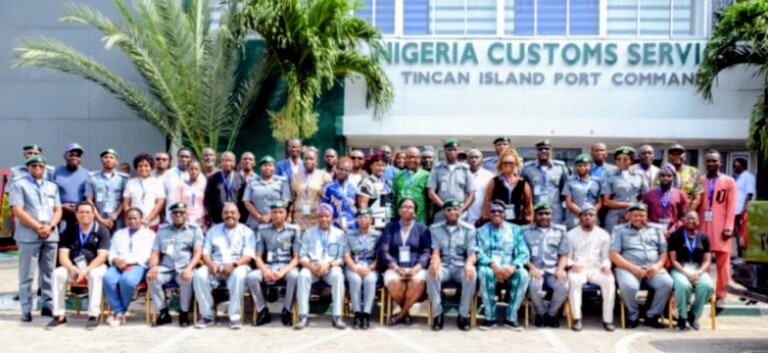
The Tin Can Island Customs Command of the Nigeria Customs Service (NCS) has organised a training workshop for maritime journalists to deepen their understanding of the Service’s ongoing trade modernisation drive, as well as its operations and procedures in line with global best practices.
This year’s edition, themed, “Compliance, Collaboration and Modernisation: Aligning The Nigeria Customs with Global Best Practices” which took place at the Command on Wednesday, December 17, 2025 was also aimed at strengthening collaboration between the NCS and the media for accurate and informed reporting.
The training featured topics on NCS Act 2023; Unified Customs Management System (UCMS) popularly known as B’odogwu; Authorised Economic Operator (AEO); Time Release Study (TRS); Global Supply Chain Security and Ethical Journalism.
In his welcome address, the Customs Area Controller (CAC), Comptroller Frank Onyeka said the workshop came at a critical stage in the ongoing transformation of the Service, which is implementing reforms with global best practices to promote economic growth and enhance national security.
He noted that the media, particularly maritime journalists, play a strategic role in information dissemination, public enlightenment, and accountability, describing an informed press as a key ally in nation-building.
According to Comptroller Onyeka, the training was designed to deepen journalists’ understanding of Customs operations, trade facilitation, compliance requirements, and modernisation initiatives, while also providing a platform for constructive engagement and knowledge sharing.
He emphasised that the Comptroller-General of Customs, Bashir Adewale Adeniyi, PhD places high priority on stakeholder collaboration, adding that the Service continues to strengthen partnerships with the media, private sector operators, sister agencies, and the public.
Session One of the training provided an overview of the Nigeria Customs Service (NCS) Act, 2023, delivered by Deputy Comptroller Chinyere Nwachukwu (LLB, LLM). She explained that the new Act repealed the Customs and Excise Management Act (CEMA), which had been in force since 1958. After 65 years, CEMA became outdated due to rapid modernisation, technological advancement, and evolving global trade policies, necessitating a new legal framework aligned with contemporary customs administration.
According to her, the NCS Act, 2023 introduces clearer institutional and legal structures for the Service, expands enforcement and investigative powers, and modernises customs procedures in line with global best practices. She highlighted key trade facilitation and compliance provisions embedded in the Act, outlined new offences introduced by the Act, and various ways to resolve dispute.
The Deputy Comptroller noted that the Act prescribes stiffer sanctions to deter violations, including imprisonment, heavy fines of up to ₦50 million, monetary penalties imposed by the Service, forfeiture of goods, and the refusal, suspension or revocation of licences. In extreme cases, the Act also provides for capital punishment as determined by the courts.
She concluded that a proper understanding of the NCS Act, 2023 would enable maritime journalists to report more accurately on trade, enforcement, and port activities, thereby promoting transparency, accountability, and informed public engagement within Nigeria’s maritime sector.
Session Two focused on the role of B’Odogwu in trade facilitation, as presented by Assistant Comptroller Mary-Anne Egwunyenga, Officer in Charge of 846. She explained that B’Odogwu is not merely an IT platform but a legally grounded and policy-backed trade facilitation and governance tool designed to support Nigeria Customs Service reforms and improve port operations.
She noted that B’Odogwu has a direct impact on cargo clearance timelines, cost of doing business at Nigerian ports, revenue assurance, and the integrity of trade data. By simplifying and automating processes, the platform makes legitimate trade faster, more predictable, and more transparent without weakening regulatory control, while also strengthening risk management and inter-agency collaboration.
Comparing B’Odogwu with legacy systems, Egwunyenga highlighted improved user access, clearer process ownership, stronger fraud prevention, and enhanced data integrity. She added that the platform offers better visibility and tracking of cargo, paperless document handling such as PAAR, smarter data management, and improved nationwide control of cargo movement through the Cargo Tracking System.
She described maritime journalists as strategic partners in the reform process, stressing that media reporting shapes public perception, investor confidence, and accountability in port operations. According to her, B’Odogwu represents compliance through automation, collaboration across border agencies, and modernisation aligned with global best practices, adding that accurate reporting is critical to public understanding of its value.
Session Three, titled “Customs Modernisation for Trade Facilitation: The Role of AEO and Time Release Study,” was presented by AC Adeiza Ibrahim, Technical Supervisor at Tin Can Customs. The session further refreshed journalists’ understanding of the AEO programme and enlightened them on the relevance of the TRS as key tools in customs modernisation.
Ibrahim explained that Nigeria’s drive to modernise customs administration is central to enhancing trade facilitation, improving competitiveness, and strengthening revenue assurance. He noted that the AEO programme and TRS are flagship instruments that align the Nigeria Customs Service (NCS) with World Customs Organization (WCO) standards while addressing long-standing bottlenecks at ports and border stations.
Session Four focused on “Strengthening Global Supply Chain Security: Collaboration under the WCO SAFE Framework of Standards,” delivered by Deputy Comptroller Azikiwe Ejidoh, Officer in Charge of Bulk Cargo, Tin Can Island Customs Command.
Ejidoh noted that security and trade facilitation have become the core priorities of modern Customs administration worldwide, stressing that while trade facilitation is essential, security must never be compromised. He emphasised that supply chain security is a collective responsibility, with all stakeholders playing critical and interdependent roles.
He explained that the WCO SAFE Framework of Standards is designed to strike a balance between trade facilitation and effective control. According to him, the framework provides a structured approach for securing and facilitating global trade through risk-based and collaborative measures.
The Deputy Comptroller outlined the five core elements of the SAFE Framework, and highlighted the three pillars of the SAFE Framework, namely Customs-to-Customs (C2C) network arrangements, Customs-to-Business (C2B) partnerships, and Customs-to-Other Government Agencies (C2G) cooperation, all of which he described as critical to achieving a secure, resilient and efficient global supply chain.
In Session Five titled “Recalibrating the Compass: Character as the True North of Maritime Journalism,” Oluwaseyi Adeyemo, Publisher of Inside Watch Africa (IWA), challenged maritime reporters to see themselves as critical stakeholders in the growth of Nigeria’s maritime industry, noting that the sector remains vital to the nation’s economic development.
He urged journalists to deliberately tell positive and balanced stories from the sector, stressing that initiatives such as the Customs Cares Initiative deserve visibility. According to him, if journalists fail to highlight credible progress and reforms, the global community may never hear about them, adding that the responsibility of projecting the industry rests largely on the media.
Adeyemo called on reporters to align their character with truth, place national interest above personal gain, and become professionals Nigeria can rely on. “If the maritime sector must grow, we must grow in character. Character is our true North. Nigeria does not need more maritime stories; Nigeria needs better maritime journalism,” he said.
Earlier, Training Coordinator, Innocent Orok recalled that the workshop was conceived in 2024 following a media report alleging that Customs caused delays in cargo clearance to extort importers, resulting in high demurrage and increased prices of goods.
He explained that the then Comptroller of Tin Can Island Customs Command, Deputy Comptroller General Dera Nnadi, clarified that such issues had been addressed over 20 years ago through various trade facilitation tools, highlighting the need to train journalists on Customs processes and procedures for accurate reporting.
Speaking further, Orok commended Comptroller Onyeka for his consistent support for the media and organising this year’s edition, describing him as competent, patriotic and committed to capacity building.
While noting that the training was a knowledge-driven initiative aimed at long-term professional growth rather than immediate financial gains, Orok urged journalists to remain focused and maximise the opportunity to acquire relevant insights.
He thanked the Comptroller General of Customs and his management team for their commitment to strengthening journalists’ capacity in line with the ongoing transformation of the Service.
The workshop concluded with the presentation of plaque/certificates to the coordinator, facilitator and resource persons, as well as certificates and modern electronic gadgets to participants to enhance efficiency in their work.