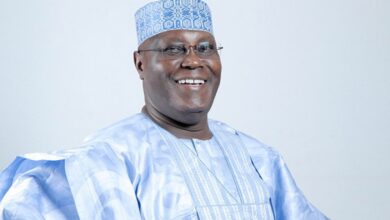
NIJ Provost Adefaye Calls for AI-Driven, Entrepreneurial Journalism Training
...Warns Local Newspapers Must Reinvent or Risk Extinction


The Provost of the Nigerian Institute of Journalism (NIJ), Mr. Gbenga Adefaye, has called for a fundamental overhaul of journalism education, urging universities and journalism training institutions to equip aspiring media professionals with artificial intelligence (AI), digital and entrepreneurial skills needed to thrive in a rapidly evolving media landscape.
Adefaye made the call on Monday while delivering a paper titled “Training the Next Generation of Journalists for Digital Innovation and Global Impact” at the Journalism Outlook Conference 2026, organised by Caleb University at the institution’s Multipurpose Hall in Imota, Ikorodu, Lagos.
The conference was themed “Reinventing Local Newspapers in the Digital Age: Innovation, Sustainability, and Global Community Impact.”
Addressing participants, the NIJ Provost stated that journalism training must move beyond traditional newsroom practices to prepare graduates for a digital-first media ecosystem increasingly driven by technology, multimedia storytelling, and artificial intelligence.

He warned that local newspapers can no longer rely on old business models if they hope to remain relevant.
“A drive round any Nigerian city today tells its own story. The printed newspaper has become something of a memento, carried by a few remaining old vendors who, like the papers they hawk, are a dying tribe,” he said.
Despite the decline in newspaper circulation, Adefaye noted that public appetite for media content has continued to grow, with audiences now consuming news across multiple digital platforms.
“The near-disappearance of the newspaper from the daily menu does not necessarily mean a decline in the consumption of media content. If anything, people probably consume more content today than they ever did,” he asserted.
Reflecting on his years as an executive at Vanguard newspaper, Adefaye recalled receiving more than a dozen newspapers daily but reading only a fraction of them, contrasting that experience with today’s digital environment where vast amounts of text, audio, and video content are accessed through mobile devices.
According to him, while newspaper brands still command respect, the industry now faces stiff competition from digital content creators, influencers, and on-air personalities who have leveraged technology to build large audiences without the overhead costs associated with traditional media organisations.
“There are now legions of publishers whose only factory is a laptop and a data subscription,” he said, adding that many content creators now perform functions traditionally reserved for trained journalists.
He stressed that technological advancement has fundamentally transformed newsroom operations, eliminating many of the rigid specialisations that once defined journalism practice.
“The today’s media professional is expected to play smart and play many roles at once,” he said.
Adefaye described artificial intelligence as the next major frontier in journalism education, arguing that AI should not be treated as an optional addition to existing curricula but integrated into newsroom training and practice. “Artificial intelligence is, without question, the next game in journalism training.”
He explained that journalism schools must now produce entrepreneurial, multi-skilled content creators capable of reporting, shooting, editing, publishing, distributing, and monetising content across multiple platforms.
He argued that the era of abundant permanent newsroom jobs is gradually giving way to contract work, freelance opportunities, and a content marketplace where success depends on quality, speed, and innovation.
To bridge the gap between training and industry realities, the NIJ Provost advocated substantial investment in digital newsrooms, television and radio studios, multimedia laboratories and communication research facilities.
He also called for expanded curricula that place digital journalism, multimedia storytelling, strategic communication, corporate communication, social media management and media entrepreneurship at the heart of journalism education.
“Digital journalism is far bigger than simply migrating newspaper stories onto a website. It integrates multimedia storytelling, data journalism, audience engagement, artificial intelligence and analytics directly into the news production process,” he explained.
On the sustainability of the newspaper industry, Adefaye observed that the traditional business model built on circulation revenue and advertising had largely collapsed, making entrepreneurship an essential component of journalism training.
He noted that future journalists must understand not only how to produce quality content but also how to sustain media businesses through emerging revenue models, including subscriptions, memberships, content licensing, events and direct audience monetisation.
Speaking on the conference theme, Adefaye pointed out that digital technology has created opportunities for local journalism to achieve global relevance, enabling stories from local communities to reach international audiences within hours of publication.
He urged journalism educators to prepare students for cross-border reporting, international collaborations and global ethical standards while maintaining strong local news values.
The NIJ Provost also welcomed recent reforms to journalism education in Nigeria, particularly the restructuring of communication programmes by the National Universities Commission (NUC) and the National Board for Technical Education (NBTE), saying the new specialised pathways better reflect the realities of today’s media industry.
Adefaye further encouraged journalism educators to embrace change rather than resist it, maintaining that AI should be seen as a tool to enhance journalism rather than a threat to the profession.
“We must teach the smart use of artificial intelligence, not as a threat to be resisted but as a tool to be mastered,” he advised.
He added: “The local newspaper, and the profession that built it, will only reinvent itself successfully if the people we train today are equipped for the world as it now is — not the world, however fondly remembered, that most of us came up in.”