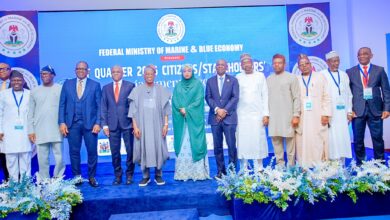

The Nigeria Maritime Administration and Safety Agency (NIMASA) and the Maritime Workers’ Union of Nigeria (MWUN) have called for an urgent review of the National Joint Industrial Council (NJIC) for Seafarers.
A statement signed by the spokesman of MWUN, Comrade John Ikemefuna on Saturday, warned that its expiration has left Nigerian seafarers vulnerable to poor working conditions and weak labour protections.
The Union noted that the absence of an updated NJIC has exposed seafarers to arbitrary employment practices and poor enforcement of agreed standards, while placing responsible ship owners at a disadvantage.
It stressed that the review of the NJIC is not merely procedural but urgent and necessary, with the outcome expected to reflect international best practices and the peculiar challenges faced by Nigerian seafarers.
According to MWUN, the outdated NJIC has undermined standards across coastal, offshore and fishery operations, making it difficult to ensure fairness, compliance and industrial harmony within the maritime sector.
The President-General of the Union, Comrade Francis Bunu also emphasised the importance of collective bargaining agreements (CBA), describing them as the cornerstone of industrial peace and productivity.
He said the union strongly advocates that CBAs should be made an integral part of the compliance checklist for ship owners and a mandatory requirement for the renewal of operating certificates and the re-registration of vessels.
Bunu also insisted that pension remittance for seafarers should no longer be treated as optional. He called on NIMASA, in collaboration with relevant regulatory agencies, to strictly enforce mandatory pension remittance for all seafarers operating in the coastal, offshore and fishery sectors.
He further advocated a comprehensive review of the NJIC that goes beyond a symbolic agreement, urging the establishment of a standing committee to monitor compliance and ensure effective implementation.
He reaffirmed the union’s commitment to dialogue, partnership and progress, stating that MWUN believes inclusiveness, fairness and enforcement are key to building a maritime sector that meets global standards and protects its most valuable assets — its people.