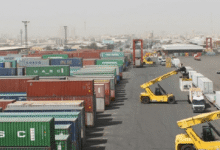

The Nigeria Customs Service (NCS) has launched the One-Stop-Shop (OSS) initiative aimed at reducing cargo clearance time to 48 hours.
The Comptroller-General of Customs, CGC Adewale Adeniyi, introduced the initiative during a stakeholders’ engagement at Marriott Hotel, Lagos, on Friday, February 13, 2026.
CGC Adeniyi recalled that around this time last year, the Service introduced the Authorised Economic Operator (AEO) programme — an initiative built on trust, compliance, and partnership with responsible operators.
His words: “That engagement marked a new phase in our relationship with the trading community, anchored on mutual confidence and shared responsibility. Today, on the eve of Valentine’s Day, we have once again chosen to engage our stakeholders with an initiative that deepens trust, strengthens transparency, and reinforces our commitment to fair and predictable processes.
“Under the leadership of President Bola Ahmed Tinubu, this has become our tradition — delivering meaningful reforms that demonstrate care, reliability, and accountability. In that spirit, the idea of ‘One Valentine, One Initiative’ captures our resolve to keep building systems that reward trust and improve service delivery, year after year.
“Today’s engagement addresses a concern shared by government, business, and citizens alike: how efficiently Nigeria moves goods across its borders, and how that efficiency shapes investment, competitiveness, and economic growth. For years, traders, manufacturers, and logistics operators have pointed to delays, overlapping checks, fragmented processes, and unpredictable interventions that increase the cost of doing business and weaken confidence in our systems.”
He noted that national assessments, Nigeria’s recent Trade Policy Review at the World Trade Organization (WTO), and the findings of the Service’s just-concluded Time Release Study (TRS) have documented these challenges, showing that while physical inspections often take only a few hours, consignments spend several days in idle waiting due largely to uncoordinated procedures and system gaps.
Adeniyi stated that these realities point clearly to structural and procedural gaps that can no longer be addressed through incremental adjustments or isolated interventions. “What is required is a coordinated, technology-enabled, and institutionally embedded solution — one that aligns policy intent with operational reality, balances facilitation with control, and places accountability at the centre of border management.”
He confirmed that the NCS has examined these findings closely, stressing that the engagement marks a decisive step towards practical, measurable, and sustainable reform. “The One-Stop-Shop initiative is firmly anchored in Nigeria’s broader business environment reforms under Executive Order 001 and the Business Facilitation Act, which emphasise transparency, service timelines, digitisation, and inter-agency coordination.”
The Customs boss disclosed that recent assessments by the Presidential Enabling Business Environment Council have acknowledged measurable progress while also highlighting persistent bureaucratic bottlenecks and weak consequence management.
“Within this reform framework, the Nigeria Customs Service has continued to reposition its systems to support national competitiveness, with improved rankings in efficiency and transparency reflecting these efforts, even as they remind us that institutional reform must remain continuous, practical, and results driven.
“Over time, risk intervention at the declaration processing stage evolved into a fragmented structure in which valuation, enforcement, intelligence, compliance, and processing units operated largely in isolation, with limited coordination and unclear accountability. This arrangement produced multiple checkpoints, sequential reviews, and repeated documentation requests, creating avoidable delays and administrative burden for traders.”
He emphasised that operational assessments and internal reviews have shown that the inefficiencies were driven more by systemic gaps than by inspection performance, adding that OSS implementation studies further indicate that frequent post-release interventions, sometimes outside port environments, added to uncertainty and compliance costs.
According to him, the cumulative challenges highlighted the need for comprehensive structural solution rather than piecemeal adjustments. “The One-Stop-Shop is designed as a unified operational framework that centralises all risk interventions within a coordinated digital and physical environment, replacing fragmented processes with an integrated clearance system.
“In line with the approved Standard Operating Procedure, the platform brings together valuation, Customs Processing Centres, intelligence, enforcement, compliance monitoring, and gate operations into a single workflow, supported by digital tracking and clearly defined escalation paths.”
CGC Adeniyi also explained that multiple checkpoints are collapsed into one coordinated decision space through automated alerts, joint inspections, and shared dashboards, ensuring that interventions are no longer isolated actions but collective, accountable, and fully traceable decisions anchored in institutional responsibility.
He pointed out that within this integrated framework, the One-Stop-Shop initiative pursues clear and measurable operational and economic outcomes:
– It reduces clearance time by eliminating duplicated reviews and sequential inspections, supporting a 48-hour clearance target and improving significantly on historical dwell times.
– It lowers compliance costs by minimising physical interfaces and discretionary interventions.
– It strengthens revenue assurance through improved profiling, intelligence integration, and coordinated enforcement.
– It enhances transparency through digital audit trails and systematic performance monitoring.
– It aligns post-clearance controls with international best practice by assigning such interventions primarily to the Post Clearance Audit Unit, reinforcing consistency, thereby accountability, and regulatory discipline across the clearance cycle.
Adeniyi said that these outcomes align with global evidence under the WTO Trade Facilitation Agreement, which estimates that effective implementation can reduce trade costs in developing economies by over 14 per cent.
He argued that technology alone does not reform institutions, revealing that this is why the deployment of the One-Stop-Shop has been supported by comprehensive process reengineering, structured officer training, and sustained change management programmes.
“Units that once operated independently now function as integrated teams, guided by shared performance indicators and clearly defined responsibilities. Recent performance assessments confirm that MDAs with strong digital workflows and coordinated decision-making frameworks achieve better service outcomes,” he said, adding that the Service is advancing towards a fully paperless Customs environment.
CGC Adeniyi disclosed that the first phase of this transition, covering core clearance, documentation, and approval processes, is scheduled for rollout by the end of the second quarter of this year.
He explained that the initiative would further reduce physical interfaces, enhance data integrity, improve processing speed, and strengthen audit controls, asserting that no border reform succeeds without strong and sustained partnership.
He equally noted that OSS promotes inter-agency collaboration, harmonised inspections, and seamless information sharing in line with the “One Government” directive.
“Sector assessments have emphasised the importance of unified interface stations and joint task forces at the ports, reinforcing the need for coordinated regulatory action. In this regard, I reaffirm the strong support of the Nigeria Customs Service for the National Single Window initiative. Customs has been actively engaged in its design and implementation, and we look forward to its formal launch by the end of the first quarter of 2026.
“When operational, the Single Window will complement the One-Stop-Shop by extending coordination across the entire border management ecosystem. The broader significance of this initiative extends well beyond Customs operations, as reduced dwell time strengthens supply chain reliability, lower transaction costs enhance export competitiveness, predictable procedures attract investment, and transparent systems reinforce public trust.
“Nigeria’s recent Trade Policy Review at the World Trade Organization acknowledged ongoing efforts to streamline customs procedures and introduce modern compliance frameworks, while urging further improvements in risk management, to which the One-Stop-Shop provides a direct and practical response,” Adeniyi remarked.
He stressed that when border processes function efficiently, industries become more competitive, employment opportunities expand, and national productivity is strengthened. “This engagement is the beginning of an ongoing reform process as the One-Stop-Shop framework will be subject to continuous review, with performance data guiding refinements, stakeholder feedback shaping upgrades, and emerging technologies integrated where they demonstrably add value.
“Throughout this process, our objective remains consistent: to facilitate legitimate trade without compromising control, to enhance efficiency without weakening compliance, and to pursue innovation firmly anchored in institutional discipline and regulatory responsibility.”
Adeniyi maintained that the platform is a deliberate shift from fragmented interventions to coordinated governance, from discretion to data, and from isolated actions to collective responsibility.
He assured stakeholders that through the reform, the Service would continue to build systems that support lawful trade, protect national interests, and serve the economy with professionalism and integrity.
The CGC also urged them to engage constructively, utilise the platform responsibly, and hold the Service to the standards it has set, affirming that progress at the border remains progress for the nation.
He further expressed gratitude for their partnership, confidence, and commitment to Nigeria’s growth.