Democracy Must Deliver Better Living Standards, Not Just Elections – Osinbajo
...Warns AI, Population Growth, Climate Change Pose New Threats to Nigeria's Future

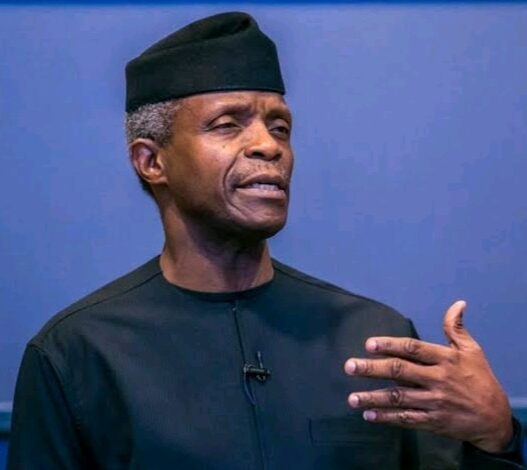
Former Vice President Prof. Yemi Osinbajo has called for people-centred governance in Nigeria and across Africa, saying democracy must go beyond elections to deliver improved living standards, economic opportunities, security, and a better future for citizens.
Osinbajo stated that democratic governments must demonstrate tangible improvements in people’s lives, warning that economic hardship, unemployment, and declining public confidence in democratic institutions could undermine the gains of democracy.
He spoke while delivering a lecture at an event marking the 59th birthday of Adamawa State Governor, Umaru Fintiri, in Yola on Tuesday, October 27, 2026.
Speaking on the theme of “Democracy, Development and the Imperative of People-Centred Government,” the former vice president noted that the expectations of Africans who fought for democratic rule in the 1990s remained largely unfulfilled after nearly three decades of democratic governance across the continent.
“Democracy promises not merely to choose leaders but a society in which political freedoms help secure economic opportunity, social progress, justice, and prosperity,” he said.
Osinbajo cited Afrobarometer surveys indicating that 64 per cent of citizens across 38 African countries preferred democracy to other forms of government, while only 38 per cent were satisfied with how democracy worked in their countries.
He stressed that the figures revealed a significant gap between what citizens expected from democracy and what governments had delivered.
He also expressed concern over public confidence in democratic institutions, citing survey findings that only 46 per cent of Africans trusted their executive governments, 37 per cent trusted parliament, 47 per cent trusted the courts, and 46 per cent trusted the police.
According to him, the figures were troubling because these institutions were essential to constitutional democracy, with parliament responsible for representing citizens and holding governments accountable, while the courts and police were expected to uphold justice and the law.
Osinbajo attributed much of the dissatisfaction with democracy to persistent economic hardship, noting that many citizens continued to struggle with unemployment, poor living conditions, and limited access to essential services.
He cited Afrobarometer findings covering 38 African countries between 2023 and 2025, which showed that 76 per cent of respondents believed their governments were performing poorly in job creation, while 73 per cent said governments were doing badly in improving living standards.
He added that 79 per cent believed governments were performing poorly in reducing the gap between the rich and the poor.
Osinbajo stated that such conditions had led many citizens to question the practical benefits of democracy when it failed to improve their daily lives.
He also pointed to declining voter turnout in Nigeria, which fell from about 44 per cent in 2015 to 35 per cent in 2019 and 27 per cent in 2023.
He noted that, although many young people remained politically engaged and willing to express their frustrations through protests and other forms of political action, there was a danger that growing dissatisfaction could weaken their faith in democracy itself.
Coups are not the answer
Osinbajo warned that growing discontent with democratic governments had coincided with a resurgence of military coups in Africa, stressing that military rule was not a solution to the failures of democracy.
He recalled that the continent had experienced 11 successful military coups in nine countries between 2020 and 2025.
“Those of us who have lived through military rule know that. That it is not an answer,” he said, adding that the historical record offered little reason to believe authoritarian rule provided a more reliable path to prosperity, justice or effective leadership.
However, he mentioned that governments must understand the frustrations that made military intervention attractive to some citizens, particularly young people.
Osinbajo cited an Afrobarometer survey indicating that 53 per cent of Africans surveyed were willing to tolerate military intervention where elected leaders abused power for personal interests. He also referenced a United Nations Development Programme (UNDP) survey in which only 11 per cent of respondents expressed a preference for military rule.
AI, population growth, and climate change
The former vice president identified population growth, climate change, and artificial intelligence as three major forces that could make the task of delivering improved living standards increasingly difficult for African governments.
On population growth, he disclosed that Nigeria was adding approximately five million people annually, creating increasing demand for food, housing, healthcare, education, electricity, transportation, and employment.
He asserted that the country’s growing population could become an economic advantage if supported by adequate investment in human development and productive jobs.
However, he warned that without such investments, population growth could deepen poverty, social frustration, and instability.
On climate change, Osinbajo pointed out that flooding, dry spells, rising temperatures, and desertification were already affecting agricultural production, destroying livelihoods and threatening food security across Nigeria.
He added that climate change could accelerate migration, intensify competition over land and water, aggravate existing conflicts and increase food prices.
The former vice president described artificial intelligence as another major challenge, particularly because of its potential impact on employment and government revenue.
He warned that advances in AI could threaten jobs in professions such as law, accounting, engineering, banking, and software development, while developments in robotics could affect various forms of manual work.
Osinbajo cited warnings by Anthropic Chief Executive Dario Amodei that artificial intelligence could eliminate as many as 50 per cent of entry-level white-collar jobs within one to five years. He also referred to concerns expressed by Microsoft co-founder Bill Gates about the social and economic disruption associated with AI.
He emphasised that the potential loss of jobs would pose a significant challenge for Nigeria, where millions of people were entering the population annually and would require productive employment.
“What happens to household incomes? What happens to consumer spending? How about government’s tax revenues?” he asked, highlighting the possible consequences if traditional sources of employment and taxation weakened.
He urged governments to consider how AI could be deployed to improve education, agriculture, and healthcare while preparing for its potential effects on jobs and livelihoods.
Osinbajo advocates people-centred governance
Against this backdrop, Osinbajo called for a renewal of the social contract between governments and citizens, arguing that democratic governance must be measured by its impact on the welfare and dignity of ordinary people.
“Democracy must not only mean that citizens have a voice in choosing their leaders, but that the exercise of public power must produce tangible improvements in the well-being of people, in their livelihoods, the opportunities that they have, and their personal dignity,” he remarked.
He explained that people-centred governance required governments to assess whether economic growth created productive employment, public spending improved lives and justice was accessible to both the poor and the wealthy.
According to him, government policies often benefitted people with money, influence or access to those in power, while many ordinary citizens continued to experience poverty, insecurity, unemployment, and inadequate public services.
He reiterated that the approach required a change in the mindset of those responsible for making and implementing public policies, particularly in countries where the majority of citizens were poor.
Osinbajo also challenged federal and state governments to develop plans for potential job losses arising from AI and determine how the technology could support essential public services.
Questions Nigeria’s spending priorities
Highlighting the importance of people-centred governance, Osinbajo recounted his experience as Vice President and Chairman of the Economic Management Team between 2016 and 2019, when the government considered a proposed ₦500 billion allocation for a national social investment programme.
He stated that the proposal, discussed during a pre-budget meeting in early 2016, was intended to support school feeding for children in public primary schools, provide collateral-free loans to traders and other small-scale operators, engage 500,000 unemployed graduates through the N-Power programme and deliver cash transfers to vulnerable Nigerians.
According to him, the proposed allocation generated debate, with concerns raised about its affordability and financial sustainability.
Osinbajo questioned why substantial spending on poor citizens was often treated as financially difficult to justify, while government interventions to stabilise financial institutions and support wealthy debtors were regarded as economic necessities.
He recalled the 2009 Nigerian banking crisis, during which non-performing loans and obligations reportedly exceeded ₦5.4 trillion, with fewer than 350 debtors accounting for 80 per cent of the amount.
He noted that government intervention to stabilise the financial system and support banking recapitalisation was justified on the grounds that a collapse could endanger depositors, businesses, and the wider economy.
However, he argued that investing in poor households, children’s nutrition, youth employment, and the livelihoods of small traders was equally compelling from an economic perspective.
“Why should public intervention to save big, wealthy debtors, and financial institutions be regarded as an economic necessity, while public intervention to improve the lives and production capacity of millions of poor citizens is so regularly dismissed as unsustainable?” he asked.
Osinbajo maintained that governments must place the welfare and productive capacity of the majority at the centre of public spending decisions, particularly as Nigeria and other African countries confront mounting economic and technological challenges.
He added that restoring confidence in democracy would depend on governments demonstrating that democratic institutions could improve the everyday lives of citizens and provide meaningful opportunities for a better future.