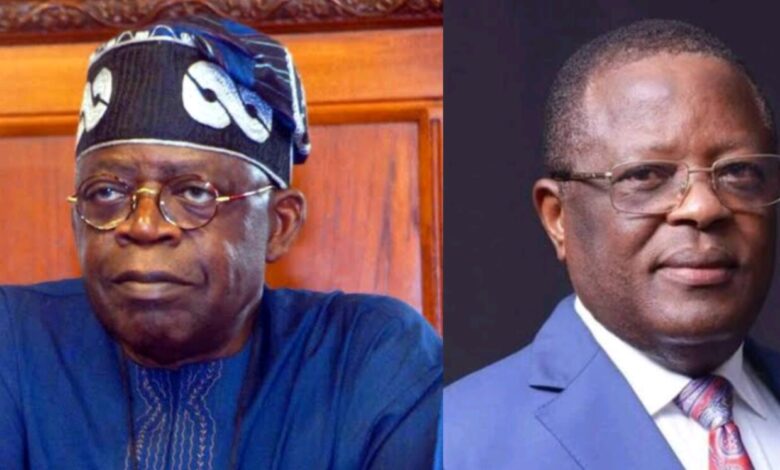
President Bola Tinubu and Minister of Works David Umahi have come under heavy criticism from Nigerians on X (formerly Twitter) following revelations that the Lagos-Calabar Coastal Highway will be diverted through sections of the existing East-West Road from Ondo into Edo State.
The proposed diversion has sparked questions about the original design of the multi-trillion-naira project, the adequacy of preliminary engineering studies, the cost of construction, and the potential economic benefits of a highway initially conceived to connect Nigeria’s coastal states.
The controversy intensified after Umahi disclosed that Tinubu had directed the Federal Ministry of Works to use the existing East-West Road rather than construct a new alignment along the affected corridor.
Quoting the President, Umahi said: “Divert, do not do any new alignments. Pass the coastal highway through the existing East-West Road.”
The Minister stated that the decision was partly informed by recurring flooding along the East-West Road, particularly around the Ughelli axis in Delta State.
He disclosed that the Federal Government plans to raise vulnerable sections of the road by about two metres above the existing level to address flooding and improve its resilience.
Umahi explained that the original alignment in parts of Ondo State also presented significant engineering challenges, including deep pits and a lack of suitable sharp sand for construction, which he said would have substantially increased project costs.
He said that the government had consequently redesigned sections 4A and 4B, covering 67 kilometres across Ogun and Ondo States, with approximately 27 kilometres in Ogun and 40 kilometres in Ondo.
According to him, the Ondo-Edo corridor, including the 45-kilometre Benin bypass, is expected to cover about 104 kilometres.
Providing updates on other sections, Umahi declared that the 47.47-kilometre first section, beginning from Victoria Island in Lagos, had been completed and was ready for commissioning. The second section, spanning 55 kilometres to the Lagos-Ogun boundary, was expected to be completed soon.
He also mentioned that sections 3A and 3B, covering 65 kilometres at the Calabar end, had achieved more than 30 per cent completion, while work continued on other stretches in Akwa Ibom and the Niger Delta.
The Minister further disclosed that surveys and procurement were ongoing for a 129-kilometre dual carriageway between the Edo-Delta and Delta-Bayelsa boundaries, with construction expected to commence in November.
However, the proposed diversion has raised concerns among Nigerians who argue that routing portions of the highway through an existing inland road could undermine the project’s original purpose and raise questions about the planning process.
Nigerians question original vision of project
Reacting to the development, Dr. Michael Abiodun, writing on X under the handle @MichaelAbiodun_, described the project as a departure from its original purpose.
“This is no longer a coastal road, it’s a political road,” he wrote.
Abiodun noted that the original plan was for a 700-kilometre highway spanning nine coastal states, designed to connect Lagos to Cross River through Ogun, Ondo, Delta, Bayelsa, Rivers, and Akwa Ibom, at an estimated cost of ₦15 trillion.
He argued that the project’s central objective was to establish a new alignment along the coastline and open up coastal communities to economic opportunities.
He pointed out that diverting sections through the existing East-West Road raises questions about whether Nigerians are effectively paying the price of a coastal highway for what amounts to repairs and upgrades of an existing road.
“Raising it by 2 metres is necessary maintenance, not wonderful engineering,” he added.
He also questioned the decision to retain the coastal highway designation if significant portions would instead follow an inland route, arguing that the recurring flooding and deterioration of the East-West Road should have been adequately considered during the planning stage.
Another user, @TundeSmilez, drew attention to the human cost associated with the coastal highway project, alleging that people had died, lost properties, and been displaced from their ancestral homes because of the project.
“Mind you, people died, people lost properties, people lost their ancestral homes because of this so called coastal road,” the user wrote, criticising Nigerians who continue to support the administration.
Calls for independent investigation
Beyond concerns about the route, some Nigerians have called for an independent investigation into the technical advice, feasibility assessments, and cost estimates that informed the project’s original design.
Utiakpanudo, writing on X, disclosed that his experience flying over the Niger Delta swamps had given him an appreciation of the region’s difficult terrain.
He maintained that a properly executed coastal highway could be one of the most significant infrastructure projects undertaken by the Federal Government in the Niger Delta.
However, he questioned the technical arguments being used to justify the changes and called for an investigation to establish whether the original proposals were based on sound engineering assessments.
“This is fundamentally an issue of public trust, professional responsibility, and accountability,” he wrote.
He questioned what Umahi communicated to Tinubu, the technical basis on which the project was presented to the public and the advice the minister provided in his capacity as an engineer and head of the works ministry.
Utiakpanudo added that if an investigation established that the government had been deliberately misled, those responsible should be held accountable.
He further argued that if the Minister were found to have failed in his professional responsibilities, he should acknowledge the failure, apologise to Nigerians and consider his position, including resignation.
Similarly, @spirit124 argued that the Minister should resign and face investigation over the controversy, reflecting growing calls among critics for accountability over the project’s direction.
Questions over surveys, costs and contract awards
The diversion has also triggered questions about whether adequate surveys and feasibility studies were conducted before construction began and funds were committed.
Opeoluwa, posting as @OpeBee, questioned Umahi’s explanation that avoiding the original alignment would increase construction costs.
“What does Dave Umahi mean by cost per kilometer will increase if they don’t divert the coastal road?” the user asked.
“So what factors were used to calculate the initial cost without diversion? This doesn’t even make sense.”
He added that the development had undermined confidence in the Minister’s ability to deliver the project as originally promised.
Ademola, whose handle is @Alkaneseries, decried that the government could not promote a 700-kilometre coastal highway, displace people, and disrupt livelihoods along the coast, only to redirect sections inland.
He argued that bypassing the Ilaje coastline in Ondo, as well as key coastal areas in Delta and Akwa Ibom, could undermine the project’s wider economic and strategic objectives.
“If David Umahi lacks the engineering foresight to deliver a genuine coastal corridor without retreating inland, he should step aside for competent leadership,” he wrote.
Another user, @Oloye, questioned the process that preceded construction, asking what surveys and valuation exercises were conducted before funds were released to Hi-Tech, the contractor handling the project.
The user also raised concerns about the reported absence of competitive bidding for a project of such financial significance and asked how much had already been released, how much more would be spent, and whether other construction companies could be engaged through competitive bidding for the remaining sections.
The questions have added to calls for greater transparency regarding the project’s procurement, financing, and implementation.
Fears over coastal communities and economic benefits
Other critics argued that the changes could deprive coastal communities of the benefits that originally justified the project.
@SemiiAkoni alleged that the highway had been intended primarily to provide improved access to major economic facilities around Lagos, including the Lekki Deep Sea Port, Dangote Refinery, and Lekki Free Trade Zone.
The user questioned why engineering challenges were now being cited to justify rerouting sections inland and whether adequate due diligence had been undertaken before construction commenced.
Meanwhile, @Necessary_Cho questioned whether the project would effectively terminate in Lagos, describing the development as an unprecedented level of deceit.
@NuesDaily described the controversy as emblematic of what the user considered poor project execution by the Tinubu administration, arguing that major infrastructure projects were often presented as long-term economic solutions before changes to their implementation undermined the promised benefits.
Similarly, @Uptownoflagos asserted that the coastal highway would effectively remain a project concentrated in Lagos and Ogun States, with other sections relying on the existing East-West Road.
“Show me a bigger scam?” he wrote.
Another user, @Manlike_ED, expressed disappointment over the development and called on Tinubu to direct Umahi to return to the original coastal highway alignment.
@Letter_to_Jack also expressed sadness over the controversy, adding to the wave of critical reactions on the platform.
Project under scrutiny
The Lagos-Calabar Coastal Highway is one of the Federal Government’s major infrastructure initiatives, intended to improve connectivity across Nigeria’s southern coastline and support economic activity along the corridor.
While Umahi has defended the proposed changes on engineering and cost grounds, the emerging controversy has shifted public attention towards the project’s original design, the adequacy of preliminary investigations, and whether the revised alignment will deliver the economic and connectivity benefits initially promised.
The criticisms circulating on X reflect demands for clearer explanations of the route changes, transparent disclosure of project costs and contracts, and assurances that communities affected by the project will not bear the consequences of planning decisions made without adequate justification.
As debate over the diversion continues, the Federal Government faces mounting pressure to explain how the revised route aligns with the original objectives of the coastal highway, what financial implications the changes will have, and whether the project will still provide the coastal access and economic opportunities used to justify its construction.
For critics, the central question is whether the government is still delivering the coastal highway Nigerians were promised or a substantially different project whose costs, benefits, and rationale require further public scrutiny.