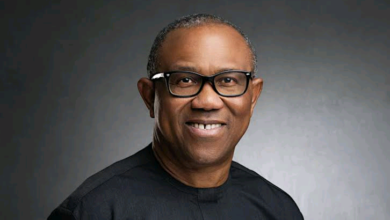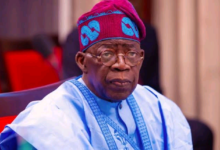
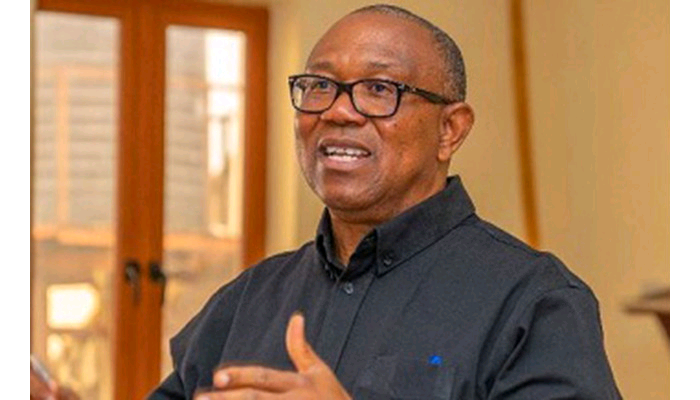
Following President Bola Tinubu’s recent remark to Catholic Bishops that there has always been hunger in Nigeria, the presidential candidate of the Nigeria Democratic Congress (NDC), Peter Obi, has criticised the statement, saying poverty and food insecurity have worsened under the current administration.
Obi expressed concern over the statement, noting that while it is true that hunger has been a part of human life and has existed in Nigeria for decades, such a statement appears insensitive to the plight of the millions of Nigerians facing worsening economic hardship today.
He called for a focus on facts and the measurable outcomes of governance, arguing that before the present administration took office in 2023, an estimated 17 million Nigerians were facing acute food insecurity, driven primarily by insecurity, armed conflict, widespread banditry, and devastating floods.
“Today, less than three years later, that number has risen to about 35 million Nigerians. Instead of improving the situation, the crisis has worsened significantly under the current administration,” he said.
Obi noted that the same trend is evident in poverty, stressing that before the current administration took office in 2023, Nigeria’s extreme poverty was estimated at 87 million people.
He, however, pointed out that current projections suggest that this number is approaching 140 million people, making Nigeria home to the largest population of people living in extreme poverty anywhere in the world.
While acknowledging that President Tinubu’s administration inherited serious challenges, Obi explained that leadership is measured not by the challenges inherited but by the results achieved.
“The government must honestly acknowledge that its response has fallen far short of what the situation demanded, with millions more Nigerians pushed deeper into poverty and hunger,” he stated.
The former Anambra State governor emphasised that the combination of persistent insecurity, poor economic management, fiscal indiscipline, wasteful public expenditure, and inadequate investment in productive sectors has compounded the suffering of ordinary Nigerians.
Obi asserted that a responsible government must prioritise investment in education, healthcare, agriculture, security, and small businesses while pursuing policies that create jobs, expand production, and lift people out of poverty.
This, he added, remains his commitment to the Nigerian people.