
The statutory basis for the Nigeria Civil Aviation Authority (NCAA) to facilitate unions’ direct access to airline employees and sanction airlines that prevent such access has come under scrutiny, following the recent industrial dispute involving aviation sector unions and airlines.
Aviation analyst, strategic consultant, and Principal Managing Partner of Avaero Capital Partners, Sindy Foster, raised the concerns in reaction to resolutions of the emergency stakeholders’ meeting convened by the Minister of Aviation and Aerospace Development, Festus Keyamo on Thursday.
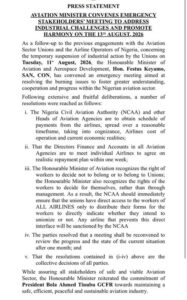
In particular, she challenged Resolution iii of the meeting, which directed the NCAA to ensure that unions have direct access to workers of all airlines to distribute forms through which employees could indicate whether they wished to unionise. The resolution further stated that any airline preventing such direct interface would be sanctioned by the NCAA.
“The Honourable Minister of Aviation recognizes the right of workers to decide not to belong or to belong to Unions; the Honourable Minister also recognizes the rights of the workers to decide for themselves, rather than through management. As a result, the NCAA should immediately ensure that the unions have direct access to the workers of ALL AIRLINES only to distribute their forms for the workers to directly indicate whether they intend to unionize or not. Any airline that prevents this direct interface will be sanctioned by the NCAA”, resolution iii read.
Foster, in a commentary titled “The Week of Buffoonery,” asked what specific provision of the Civil Aviation Act 2022 or the Nigeria Civil Aviation Regulations gives the NCAA the statutory authority to facilitate union access to airline employees and sanction an airline over the matter.
She also questioned the statutory basis upon which the Minister could direct an autonomous aviation regulator to exercise its sanctioning powers in an industrial relations matter.
According to her, the development raises concerns about the apparent blurring of institutional boundaries within the aviation sector.
Foster noted that the controversy began with unions becoming involved in a statutory regulatory matter concerning the Ticket Sales Charge (TSC) and Cargo Sales Charge (CSC), despite subsequently acknowledging that they were “not regulatory enforcers”.
She said the NCAA had indicated that it was already engaging the affected airlines and that its Director-General, Civil Aviation Authority (DGCA), had specifically asked the unions not to picket.
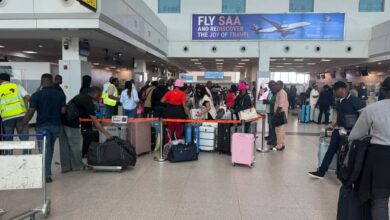
“Nevertheless, the unions proceeded. Airport access was obstructed, airline operations were disrupted and passengers across the system were affected,” she said.
The analyst also raised questions over a reported Federal High Court judgment concerning the unions’ interaction with airline employees, asking whether the judgment was considered before Resolution iii was agreed.
Foster further questioned the statement that the resolutions represented the “collective decisions of all parties”, asking which parties and airlines were represented at the meeting and whether they agreed to the disputed resolution.
Beyond the unionisation issue, she expressed concern over reports that a committee comprising what she described as “insiders, outsiders and appointees” would look into the events and produce a white paper within 180 days.
She questioned whether such a process constituted a formal investigation, arguing that competent authorities with statutory investigative powers should be responsible for determining what happened.
Foster also criticised what she described as the apparent focus on the seizure of three Air Peace buses following the disruption, while broader questions surrounding the incident remained unanswered.
She said there were videos of the disruption and allegations of assault and intimidation, alongside questions about who blocked airport access, how individuals gained access to restricted areas, who authorised what actions, and the roles played by aviation security, the Federal Airports Authority of Nigeria (FAAN) and the NCAA before, during and after the incident.
For Foster, however, the most troubling aspect of the developments was the impact on passengers, who she said bore the cost of the dispute despite having no role in it.
“They pay the fares. They fund the airlines. Through the 5% TSC they fund the aviation system itself,” she said, stressing that passengers were unable to access airports or travel while flights across airlines were affected.
Foster warned that the developments could undermine confidence in Nigerian aviation if institutional boundaries and statutory responsibilities were not clearly respected.
She said the situation could create concern among international investors, financiers, lessors, insurers, airlines and passengers about the stability and predictability of the Nigerian aviation environment.