
The Danish Government has reaffirmed its commitment to supporting the development of Nigeria’s maritime sector, calling for stronger collaboration among government agencies, the private sector and other stakeholders to unlock the potential of the blue economy.
Speaking at the maiden Blue Africa Conference and Exhibition 2026 in Lagos on Thursday, the representative of the Danish government, Jettte Bjerrum, Consul General, Head of Economy Diplomacy said maritime activities remained central to Denmark’s economy and international trade, noting that the country had successfully transformed its maritime industry through coordinated policies, private-sector investment and institutional collaboration.
Bjerrum said Denmark’s experience showed that the development of a sustainable maritime sector required government agencies, businesses and educational institutions to work together in developing ports, marine resources, skills and supporting infrastructure.
According to her, the maritime and agricultural sectors are closely connected, particularly in addressing food security, food losses, logistics and transportation.
“Food security, food loss, logistics and transportation, also at sea, are very, very important to bring these things together,” she said.
The Danish government also highlighted the role of Danish companies, particularly Maersk and APM Terminals, in Nigeria’s maritime development, saying the companies had made significant investments in port infrastructure, equipment, education and electrification.
Bjerrum noted that the companies had also worked closely with Nigerian authorities in developing policies aimed at creating a more effective and inclusive maritime environment.
“Maersk and APM Terminals have invested heavily in Nigeria, in the port setups, in education, in electrification of the ports, in equipment and also standing shoulder to shoulder with the authorities in order to develop policies that work for everybody,” the representative said.
She stated that the emergence of new digital companies and the transition from manual to digital processes would help improve efficiency and drive innovation across the maritime value chain.
Bjerrum further stressed the need for a full value chain approach to maritime development, urging stakeholders to use platforms such as the Blue Africa Conference to build partnerships and agree on practical solutions to challenges confronting the sector.
Commending the organisers of the conference, the Danish Government described the maiden edition as an important platform for bringing stakeholders together, noting that greater coordination among existing maritime initiatives would help reduce fragmentation and make it easier for stakeholders to identify priorities, mobilise resources and implement projects.
Bjerrum said the key questions should focus on what stakeholders could achieve together, who needed to be brought around the table and how projects could be financed.
According to her, feasibility studies and pilot projects are important starting points for large-scale development, as stakeholders need to demonstrate that innovative ideas can work before expanding them.
“You need to start small in an innovation way of thinking in order to scale up your big projects, but you need to start small in order to show that things can work.”
Bjerrum emphasised that Nigeria’s maritime sector was not only important to the country but also to Denmark and the wider West African region, stressing the need for continued cooperation and investment.
She expressed confidence that stronger partnerships between Nigeria, Denmark and other stakeholders could accelerate the development of the region’s maritime economy.
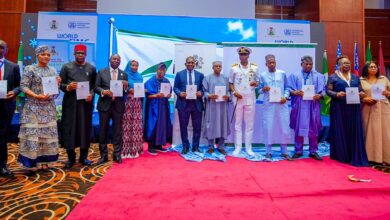
The Blue Africa Conference and Exhibition 2026, which opened in Lagos on August 13, is a two-day event holding at the Lagos Continental Hotel, Victoria Island, bringing together stakeholders from government, maritime businesses, investors, development partners and other sectors to explore opportunities within Africa’s blue economy.
The conference is the first edition organised by the Maritime Organisation and other stakeholders behind the Blue Africa initiative, with discussions focusing on how Africa can better harness its marine and maritime resources for economic growth, job creation, food security and sustainable development.