
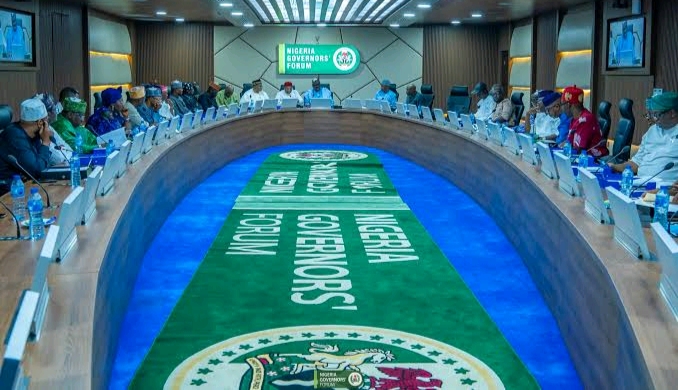
The Nigeria Governors’ Forum has approved the establishment of the NGF Academy and Leadership Centre as a flagship Directorate within its Secretariat to strengthen public-sector leadership, institutional capacity, and governance reforms across the country’s 36 states.
The Director, Media and Strategic Communications, NGF Secretariat, Yunusa Tanko Abdullahi, announced the initiative in a statement dated November 11, 2026.
The Academy is designed to provide executive capacity development, applied research, governance advisory services, digital innovation and structured peer learning within a unified, non-partisan institutional framework responsive to the governance realities of subnational governments.
According to a concept note prepared by the NGF Secretariat, the initiative seeks to develop competent, reform-minded and future-ready leaders capable of addressing emerging governance and development challenges at the state level.
It is positioned as the Forum’s subnational capacity development centre of excellence, as well as a think-tank and global interface for leadership and innovation.
The Academy will serve three tiers of state leadership — executive and strategic leadership, covering Governors and their Deputies; cabinet leadership, comprising Secretaries to State Governments, Chiefs of Staff, Commissioners, Special Advisers, Senior Special Assistants and Local Government Chairmen; and institutional leadership, covering Heads of Service, Permanent Secretaries, Directors-General, agency and departmental heads, Board Chairs and senior technical officers.
Its flagship programmes include the Governors’ Strategic Leadership and Legacy programme, designed to support serving, incoming and outgoing Governors and their Deputies through executive leadership programmes, policy retreats and structured induction.
Others are the Cabinet Leadership programme, which aims to strengthen State Executive Councils in policy design and implementation, and the Institutional Governance and Sustainability programme, which focuses on administrative excellence, institutional continuity and improved service delivery.
The Academy’s training and development activities will cover strategic leadership, public-sector ethics, negotiation strategy, adaptive management, change implementation, and sector-specific governance challenges.
These will be delivered through 12 Sector Hubs covering areas such as public finance, health, agriculture, infrastructure, trade and investment, security, digital development, and climate.
The initiative will also establish innovation and foresight laboratories to support applied research, data analysis, case studies, policy briefs and design thinking, while providing technical advisory services to state governments in areas including institutional reform, fiscal sustainability, investment facilitation, and performance management.
It will further promote structured peer-learning platforms and communities of practice to enable state governments to exchange experiences, share policy innovations, and replicate successful reforms.
The concept note provides for a shared competency framework across programmes, with participants’ progress assessed through personal action plans under the Academy’s Monitoring, Evaluation, Accountability, Learning and Feedback (MEAL-F) framework.
Gender Equality, Disability and Social Inclusion (GEDSI), digital and data innovation, and sustainability will also be integrated across its competency domains.
Programme delivery will adopt a blended and hybrid approach, combining online learning through the NGF electronic Learning Management System (eLMS) with in-person executive sessions and peer-learning forums.
The platform will provide virtual classrooms, mobile and offline access, artificial-intelligence-enabled learning tools, data analytics, role-based programmes, performance-tracking dashboards and digital certification across the 36 states. It will also integrate with the NGF Repository, e-Library and website.
Under its proposed governance structure, the Academy will operate through a two-tier arrangement comprising a Governing Council and the NGF Academy and Leadership Directorate.
The Governing Council, comprising NGF Secretariat leadership, development partners and sectoral experts, will oversee programme quality, approve work plans and budgets, and provide institutional accountability, while the Directorate will coordinate implementation, stakeholder engagement, monitoring, and evaluation.
The implementation framework spans 2026 to 2036, with four phases covering institutional establishment, operational development, programme expansion and long-term sustainability.
The first phase, scheduled for April to September 2026, focuses on strategic planning, institutional arrangements, curriculum development, pilot programmes and partnership development.
The second phase, from October 2026 to June 2027, will strengthen operational structures, develop the digital learning platform, engage faculty and technical personnel, and formalise strategic partnerships.
The third phase, covering July 2027 to June 2030, will focus on expanding leadership and sectoral programmes, applied research and governance advisory services.
The final phase, from July 2030 to June 2036, envisages nationwide programme delivery, the establishment of regional learning hubs and the operationalisation of an NGF Leadership Endowment and Innovation Fund to support long-term sustainability.
The Academy will collaborate with national, continental, and international institutions on curriculum development, applied research, faculty exchange, access to international expertise and co-financing arrangements.
Prospective and flagship strategic partners identified in the concept note include the National Institute for Policy and Strategic Studies (NIPSS), Nigerian universities, the Mo Ibrahim Foundation, Kenya School of Governance, Nelson Mandela School of Public Governance, Forum of Federations, World Bank Institute, Oxford Blavatnik School of Government, United Nations Development Programme, UNICEF, Ford Foundation and Clinton Foundation, among others.
Beyond Nigeria, the Academy aspires to extend its activities across West Africa, sub-Saharan Africa and the wider continent, with the ambition of becoming a flagship institution for subnational governance in Africa.
In the immediate term, it will operate within the existing institutional structures of the NGF Secretariat, with a long-term vision of becoming a full-fledged subsidiary of the Forum.
The initiative is expected to provide a common institutional platform for strengthening public-sector leadership, improving policy implementation, and promoting more effective governance across Nigeria’s subnational governments.