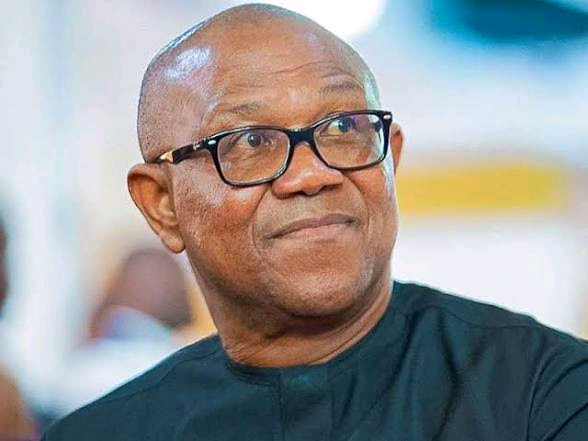
Former Anambra State Governor, Peter Obi, has highlighted his administration’s road infrastructure projects between 2006 and 2014, saying his government pursued an integrated road network aimed at connecting all 177 communities in the state and opening up rural areas to economic opportunities.
Obi, who disclosed this in the fifth instalment of his account of his administration’s development programmes, stated that the road projects were deliberately distributed across the three senatorial zones to improve connectivity, facilitate commerce, and address years of infrastructural neglect in rural communities.
He said that his administration asphalted more than 900 kilometres of roads during his eight years in office, while also constructing 28 bridges and more than 50 culverts across the state.
The presidential candidate of the Nigeria Democratic Congress (NDC) explained that the objective was to ensure that road infrastructure served the entire state rather than concentrating development in major cities or politically important locations.
Obi acknowledged the contributions of former Governor Chris Ngige, noting that his administration continued and completed several road projects initiated by the previous government rather than abandoning them.
Among the inherited projects completed by his administration were the Owerri-Ezukala-Umunze-Umuchu-Amesi-Uga-Igboukwu Road, the Iseke-Orsumoghu-Ukpor-Utu-Nnewi-Awka-Etiti Road and the Ideani-Otuocha corridor.
He also cited projects such as the Amansea-Ebenebe Road, Aguleri-Umueze Anam-Mmiata Road, Nnewi-Ozubulu-Okija Road and the Old Onitsha-Awka Road as part of the major corridors improved during his tenure.
The former governor noted that particular attention was given to communities that had experienced prolonged infrastructural neglect, especially in Anambra West, where riverine terrain had made transportation difficult.
He identified the construction of the Umueze Anam-Mmiata Road and associated bridge infrastructure as an important intervention that improved access to previously difficult-to-reach communities, particularly during the rainy season.
Obi also recalled the construction of the approximately 42-kilometre Anaku-Omor-Ifite Ogwari-Umueje-Omasi Road in Ayamelum Local Government Area, describing it as the first major road project flagged off by his administration after assuming office in 2006.
He said that the road opened up an important agricultural area, connecting farming communities, and improving their access to markets.
On bridge infrastructure, Obi listed the Odor River Bridge along the Nibo-Umuawulu-Awgbu-Amaokpala-Oko Road, the Ezu River Bridge along the Amansea-Ebenebe-Ugbenu-Ugbene-Awba-Ofemili Road, the Umueze Anam-Mmiata Bridge and the Ogbanabo Bridge connecting Okpuno and Isuaniocha among the major projects undertaken.
He particularly highlighted the Odor River Bridge, which he said measured approximately 165 metres and provided a reliable crossing for communities along the Awgbu-Amaokpala corridor.
Beyond rural connectivity, Obi mentioned that his administration also improved road infrastructure in the state’s major commercial and industrial centres, including Onitsha, Awka, and Nnewi.
In Onitsha, projects covered the Bridge Head, Upper Iweka, Zik’s Roundabout and other commercial areas, alongside improvements to roads within the Onitsha Government Reserved Area and Harbour Industrial Estate.
In Awka, he cited the dualisation and lighting of Zik’s Avenue, improvements to internal roads and connecting routes, while road projects in Nnewi strengthened access to industrial and commercial communities.
Obi further disclosed that his administration established the Anambra State Road Maintenance Agency (ARMA) in August 2008 through an enabling law passed by the State House of Assembly.
He stressed that the agency was established to provide a permanent framework for maintaining state roads, repairing failed pavements, clearing drains, and responding to road deterioration.
According to him, the agency was equipped with graders, rollers, heavy-duty trucks, and other maintenance machinery, while a dedicated office complex was provided to strengthen its operations.
He added that his administration also initiated the establishment of the Anambra State Materials Testing Laboratory to improve the quality of construction materials and workmanship in public infrastructure projects.
The laboratory was designed to test soil, aggregates, sand, cement, water, chemical materials, and steel reinforcement, among other construction materials.
Projecting his infrastructure vision for Nigeria, Obi emphasised that Nigeria needed an integrated transportation network connecting agricultural communities to markets, industrial centres to distribution networks, and rural populations to essential services.
He maintained that national infrastructure development should prioritise the rehabilitation of existing roads, the construction of economically productive routes, and the establishment of effective maintenance systems.
Obi added that road projects must be properly designed, transparently procured, adequately funded, professionally supervised, and subjected to independent quality control.
He further stated that the experience gained in Anambra would inform his approach to national infrastructure development, with emphasis on deliberate planning, prudent resource management, accountability, and measurable results.