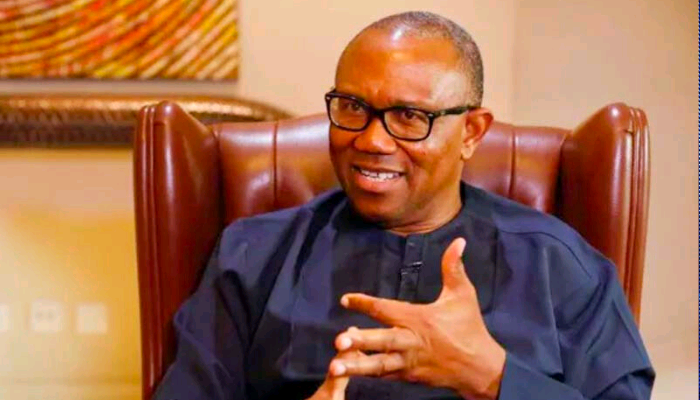
Former Anambra State Governor, Peter Obi, has detailed how his administration rebuilt government institutions, strengthened public administration, and reduced the cost of governance as part of efforts to establish a solid foundation for sustainable development in the state.
Obi, in the second part of his account of his administration’s achievements under the Anambra Integrated Development Strategy (ANIDS), explained that institutional rebuilding was one of the government’s foremost priorities, noting that effective delivery of development programmes required strong and functional institutions.
He stated that the physical and administrative structures of governance were in deplorable condition when he assumed office, making it necessary to rebuild the executive, legislature, judiciary, civil service, and local government system.
The presidential candidate of the Nigeria Democratic Congress (NDC) disclosed that his administration rebuilt, re-equipped, and furnished the Government House in Awka, which had been vandalised and burnt in 2004. The administration also rehabilitated the Governor’s Lodge in Amawbia and constructed a new one in Onitsha to strengthen executive presence across the state.
In the legislative and judicial arms of government, Obi said that the Anambra State House of Assembly Complex in Awka was rehabilitated to provide lawmakers with a more conducive working environment. Vehicles were also provided to legislators to facilitate their duties.
He further affirmed that brand-new vehicles were provided to High Court judges, describing it as the first time such provision had been made in the history of the state. Magistrates also received vehicles for the first time since the creation of Anambra State.
On the civil service, the former governor explained that his administration addressed the challenge of Ministries, Departments and Agencies (MDAs) operating from scattered rented apartments by constructing the two-phase Chief Jerome Udoji State Secretariat Complex, comprising Blocks 1 and 2.
The complex brought the MDAs together under one roof, improved administrative coordination, and provided civil servants with a more suitable working environment.
Named after Chief Jerome Udoji, the first indigenous Chief Secretary of the Eastern Region during the First Republic, the complex also recognised his contributions to public administration and the civil service tradition.
Obi added that permanent secretaries and directors were provided with vehicles for the first time in the state’s history to facilitate the discharge of their administrative responsibilities. He noted that his administration also facilitated the establishment of the Federal Secretariat Complex in Awka to strengthen institutional collaboration between the state and federal governments.
At the grassroots, the presidential candidate said that his administration embarked on the construction of new local government secretariat complexes, equipped existing ones, and renovated facilities that required rehabilitation.
Among the new complexes constructed were those in Onitsha North, Onitsha South, and Dunukofia. The administration also renovated the Awka South headquarters and constructed new facilities in Anaocha, with its headquarters at Neni.
Other facilities provided across local government headquarters included administrative and finance blocks, traditional rulers’ council buildings, tax offices, education and health blocks, sports clubs, amusement parks, and works buildings.
On the cost of governance, Obi stated that his administration adopted financial discipline by cutting waste, discouraging ostentatious expenditure, and redirecting public resources towards infrastructure and human development.
He emphasised that prudent management of public funds should go beyond accumulating savings to ensuring that every kobo entrusted to government delivers value to the people.
He argued that public office should be regarded as a responsibility rather than an opportunity for personal enrichment or patronage, stressing that state resources must be deployed for the common good.
Reflecting on the lessons from Anambra, Obi pointed out that purposeful leadership, strong institutions, financial discipline, and clearly defined priorities could produce tangible results even with limited resources.
He asserted that Nigeria’s challenges were not limited to inadequate resources but also included poor management, weakened public institutions, wasteful expenditure, and misplaced priorities.
The former governor mentioned that the principles and commitment that guided his administration in Anambra would also guide his approach at the national level, expressing confidence that Nigeria could build institutions that work and ensure public resources serve the people.
Obi confirmed that the next instalment of the series would focus on his administration’s interventions in the education sector, including projects, investments, and measurable outcomes.
He invited Nigerians to scrutinise the claims and achievements presented in the series, reiterating that his administration’s record could be independently verified.