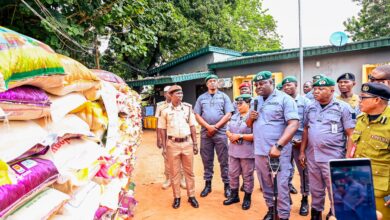

The Acting Customs Area Controller of Ogun I Area Command of the Nigeria Customs Service (NCS), Deputy Comptroller Oladapo Afeni, speaks with the Maritime Correspondents’ Organisation of Nigeria (MARCON) on the Command’s anti-smuggling achievements, trade facilitation reforms, revenue generation, export promotion, challenges of policing the Nigeria-Benin border, corporate social responsibility projects, and efforts to strengthen collaboration with host communities.
Excerpts.
Q: The Ogun I Area Command has intensified its anti-smuggling operations in recent months. What has the Command achieved so far, in the last six months?
We have significantly intensified our anti-smuggling operations. The Command recorded major seizures valued at over ₦4.6 billion in the second quarter of this year. Over the last six months, we have handed over about 30,000 parcels of cannabis, equivalent to over 12 tonnes to the National Drug Law Enforcement Agency (NDLEA). Beyond cannabis, we have also intercepted and handed over methamphetamine and heroin to the NDLEA.
Similarly, we have handed over military uniforms to the appropriate security agencies in the spirit of inter-agency collaboration. We have seized several other prohibited items that economic saboteurs attempted to smuggle in and out of the country. Overall, I believe the Command has performed remarkably well in the area of anti-smuggling.
Q: Trade facilitation remains one of the core mandates of the Service. What measures have you introduced to make legitimate trade easier?
When I assumed office, there were numerous checkpoints along this corridor. Today, we have reduced them to only two strategic locations, Ajilite and Ihumbo. We deliberately removed unnecessary checkpoints because excessive roadblocks do not support trade facilitation. Our objective is to ensure that legitimate traders can move their goods with minimal delay while maintaining effective enforcement. The response from stakeholders has been very positive.
Q: What are the major operational challenges confronting the Command?
The biggest challenge remains the terrain. Some parts of Ogun State have inadequate telecommunications coverage, making communication and rapid deployment difficult. Another barrier to our work is the topography. So, even if you have credible information or intel about smuggling activity taking place, the time it takes you to react might not be what it should be.
The peculiar boundary demarcation between Nigeria and the Benin Republic is also a challenge. There are instances where a building’s sitting room is located in Nigeria while the bedroom is in Benin Republic. Situations like these sometimes makes it very difficult to effectively do our job and require officers to operate with a high level of professionalism and intelligence.
To address these challenges, the Service is deploying geospatial intelligence technology that will enable real-time border monitoring and faster dissemination of intelligence from the headquarters.
We also recognise that some border communities have historically viewed smuggling as a way of life and means of livelihood. That is why, beyond enforcement, we are engaging in sustained sensitisation and encouraging legitimate economic activities because people need viable alternatives.
Q: How has the Command strengthened its relationship with host communities, and what impact has this had on enforcement operations?
We have prioritised engagement with traditional rulers, opinion leaders and other community stakeholders because they play a vital role in influencing public behaviour.
For instance, we have intensified our engagement in the Imeko axis, where virtually all our narcotics seizures originate. We are working with community leaders to educate their people on the dangers of drug trafficking and abuse.
Our intelligence indicates that most of the cannabis, popularly known as Ghana Loud originates from Ghana and passes through Togo and Benin Republic before entering Nigeria. The border communities merely serve as transit points. We are therefore discouraging participation in the illicit trade. The profitability is enormous because one tonne of these psychoactive substances is worth about the same as ten truckloads of rice.
There was a time some people were saying the Command was making more seizure of cannabis than other items. The encouraging development is that now, our host communities are on the same page with us and increasingly supporting our operations. I just concluded a meeting with the indigenous people of Idiroko, and we are all working together to combat the illegal movement of narcotics, Premium Motor Spirit (PMS) and other prohibited goods.
Q: How has the Command performed in revenue generation?
As of the end of June, the Command had generated ₦663.26 million in revenue. Since we are already in July, that figure has certainly increased. Considering the nature of Ogun I as predominantly an enforcement command, I believe we are performing well, and we expect to record even better results in the coming months.
Q: What progress has the Command recorded in promoting legitimate exports?
We have made significant progress in export activities. For the second quarter of this year, the Command recorded a total export volume of 20,972 metric tonnes with Free On Board (FOB) value of over one billion Naira from products such as white talc, crushed thermal coal and compressed natural gas products. This is a positive signal for non-oil exports and cross-border trade, as the Command recorded no export activity during the same period in 2025.
As I mentioned earlier, Ogun I is primarily an enforcement command, but we understand that enforcement alone is not enough. People who have seen smuggling as a way of life must be encouraged to embrace legitimate trade and provided with alternatives.
Export operations have fully resumed, and traders who comply with all documentation requirements can move their goods without hindrance. We are committed to facilitating lawful trade while remaining uncompromising against smuggling.
Q: Aside from enforcement and stakeholder engagements, what initiatives is the Command undertaking to support host communities?
The Command through the Customs Cares Initiative currently have three Corporate Social Responsibility projects ongoing; the renovations of a hospital in Imeko, a secondary school and a jetty both in Ijofin.
The jetty is important because many residents rely on water transportation to connect with Badagry. The jetty is about 40 per cent completed, and when finished, it will greatly improve mobility for the local communities.