
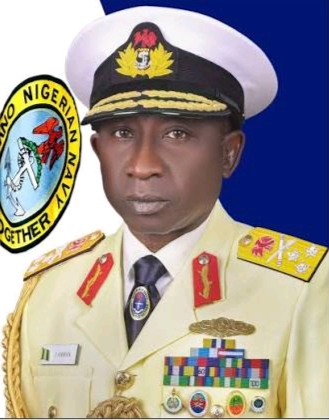
The Chief of the Naval Staff, Vice Admiral Idi Abbas, has unveiled a Combined Maritime Task Force and announced the addition of three new ships to the Nigerian Navy’s fleet as part of efforts to strengthen maritime security in the Gulf of Guinea and beyond.
Vice Admiral Abbas made the announcement during the International Fleet Review held to commemorate the 70th anniversary of the Nigerian Navy at Eko Atlantic City, Victoria Island, Lagos on Monday.
Addressing President Bola Tinubu, senior government officials, military leaders, foreign naval representatives, security agency heads, maritime sector stakeholders, and other dignitaries, the Naval Chief stated that the establishment of the Combined Maritime Task Force was the result of sustained collaboration among regional and international naval partners.
According to him, the task force will remain on standby to ensure maritime security in the Gulf of Guinea, combat emerging maritime threats and support humanitarian and peacekeeping operations across the West African sub-region.
He noted that collaborative efforts among navies operating in the region had contributed significantly to maintaining the Gulf of Guinea’s zero-piracy status, describing the achievement as a testament to the shared commitment of maritime nations to securing regional waters.
Vice Admiral Abbas also disclosed that the Nigerian Navy had advanced its fleet recapitalisation programme with the addition of three new ships, a development he said would enhance the service’s operational capabilities and strengthen maritime security across the country’s territorial waters.
“With your esteemed support and leadership, we have diligently focused on and advanced our fleet recapitalisation, culminating in the proud addition of three new ships to our naval fleet today,” he said.
The Naval Chief further revealed that the Navy was embracing emerging technologies, including unmanned aerial vehicles and artificial intelligence, to improve maritime domain awareness and strengthen surveillance capabilities.
He explained that the technologies had significantly improved the Navy’s ability to detect and respond swiftly to threats while enhancing operations against crude oil theft, illegal bunkering, smuggling, and other maritime crimes.
Beyond technology-driven solutions, Abbas stressed the importance of human capacity development, noting that the Navy remained committed to training personnel to the highest professional standards.
As part of that effort, he announced the induction of the inaugural batch of 328 Nigerian Navy Marines, describing the newly established elite unit as a major enhancement to the Navy’s operational capabilities.
He declared that the marines were trained in collaboration with allied partners and would play a critical role in maritime security operations, counter-terrorism efforts, and responses to inland security threats.
While acknowledging the progress made so far, the Naval Chief reaffirmed the Navy’s commitment to tackling emerging maritime threats and fostering a secure maritime environment capable of supporting economic growth and national prosperity.
He also pledged the continued loyalty of officers and ratings of the Nigerian Navy to President Tinubu and the Constitution of the Federal Republic of Nigeria.








wccl53