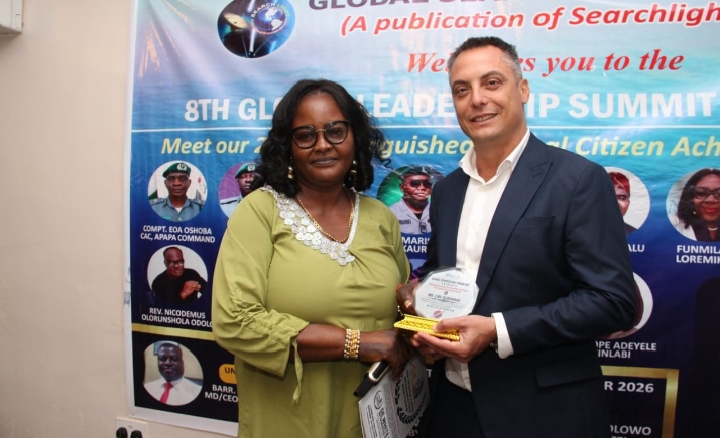
The General Manager, LTT Coastal and Marine Services Limited, Liav Zilberman, says the effective use of technology and deliberate investment in human-capital development are critical to building a stronger, safer and more efficient Nigerian maritime industry.
Zilberman stated this at the 8th Global Leadership Summit & Award 2026, themed, “Transformative Leadership for Sustainable Growth: Driving Innovation, Institutional Excellence and National Development”, on Saturday, in Lagos.
He said technology should be deployed to improve maritime operations while giving professionals better tools, information and opportunities to perform effectively, rather than being viewed simply as a replacement for human expertise.
“Technology should therefore not replace our people. It should give them better tools, better information and better opportunities to succeed.”
According to Zilberman, LTT’s experience shows that innovation does not necessarily require expensive or complicated technology, but can begin with a critical examination of existing processes and a willingness to find better ways of doing things.
He said the company has focused on using technology to improve operational efficiency, strengthen processes and empower its workforce, stressing that the people closest to maritime operations often have valuable information that can improve decision-making.
Zilberman explained that one of the company’s key initiatives is the ORI System, developed in-house to provide a centralised operational picture of its fleet.
He said the system brings together information on vessel technical status, fuel quantities, crew and manning status, vessel locations, spare-parts requirements and other operational details, enabling management to access critical information more quickly.
He added that the system has helped move information from being scattered across WhatsApp messages, emails, spreadsheets and phone calls to a more centralised platform, improving planning, communication and decision-making while reducing downtime.
Another area of focus, he said, is maintenance, where LTT uses the MARAD system to plan maintenance activities across its fleet and manage related operational requirements.
Zilberman explained that the approach is designed to move the company from reacting to equipment failures to anticipating maintenance needs and addressing them before they become operational problems.
He said technology has also been used to strengthen communication between management and vessel crews through a digital guided questionnaire that allows captains to report work quality, technical problems, operational issues, unusual events and safety observations in real time.
“When you give people an easy and structured way to report information, they report more. And when people report more, management understands the operation better.”
Zilberman said the initiative has improved the quantity, quality and consistency of operational information available to management, while giving captains a stronger voice in the management of operations.
He noted that the company has also incorporated technology into training, including the production of short internal learning videos that cover procedures, technical issues, safety lessons, operational mistakes and good practices.
According to him, the approach allows employees to access practical lessons beyond conventional periodic training sessions, while creating an internal knowledge library that can also benefit new employees.
LTT has also introduced drones for operational documentation and training, enabling the company to use footage from its own vessels and working environment to make training more practical and relevant.
Zilberman said the company combines technology with practical experience and mentorship in developing tug captains, including the use of the Nigerian Ports Authority simulator, practical demonstrations, a small demonstration boat for ASD tug operations, videos and real operational examples.
He stressed that technology should complement rather than diminish professional standards, noting that simulation allows young captains to practise handling situations in a controlled environment before encountering them on real vessels.
Zilberman said LTT’s human-capital development efforts extend to cadets undergoing their sea-time programmes, with the company seeking to ensure that they leave with more than the required number of days at sea.
He explained that the company’s empowerment programme combines professional training and practical exposure with mentorship, with experienced personnel encouraged to share both technical knowledge and lessons from their own careers.
He said the objective is to equip young maritime professionals with knowledge, confidence, professional skills and the inspiration to develop into future leaders.
“Leadership does not come from a job title. Leadership is developed through responsibility, experience, learning and the ability to positively influence others.”
Zilberman said there is a direct connection between better processes, improved performance and leadership development, noting that employees equipped with responsibility, information, training and appropriate tools are more likely to think beyond simply completing assigned tasks.
He identified five lessons from LTT’s experience: innovation does not always require a huge budget; technology should be built around operational needs; data must lead to better decisions; employees should be empowered with responsibility and the right tools; and companies must invest in the next generation.
Looking ahead, Zilberman said Nigeria has enormous maritime potential, including its coastline, major ports, offshore activities and pool of talented professionals.
He said companies have a responsibility to create an environment where that potential can be converted into a safer, smarter and more efficient maritime industry.
Zilberman said LTT sees its role as extending beyond vessel operations to developing people, improving standards, building knowledge and creating an organisational culture in which employees understand their ability to contribute.
He said the future of the maritime industry would be shaped not only by artificial intelligence, automation, digitalisation, autonomous vessels and big data, but also by the people who use and manage those technologies.
Zilberman said LTT would continue to invest in its people, improve its operations and work with the Nigerian maritime community to strengthen the sector.
He added that the company is proud to operate in Nigeria and contribute to the growth of the country’s maritime economy.