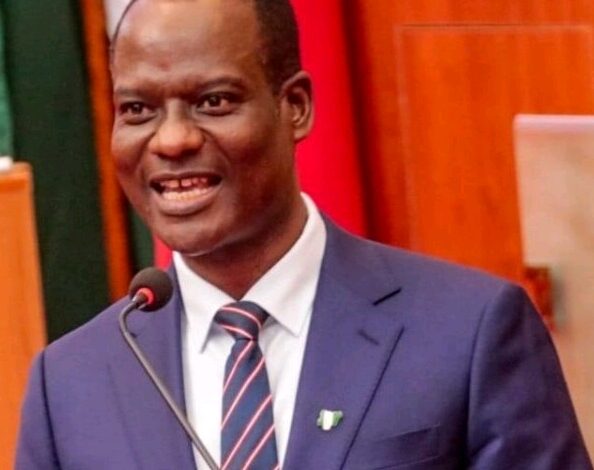
The Minister of Finance and Coordinating Minister of the Economy, Taiwo Oyedele, has explained why petrol prices cannot drop to ₦400, ₦500, ₦800 or ₦1,000 per litre.
Oyedele argued that local refining would not automatically translate into lower petrol prices, noting that crude oil has a market value and that its production, transportation, and processing entail significant costs.
He made this known during an interview on Channels Television’s Politics Today on Friday, October 9, 2026, while responding to questions about the possibility of reducing petrol prices through domestic refining.
“You cannot cut the price of petrol to ₦400, not ₦500, not ₦800, not ₦1,000. It’s simple arithmetic,” he said.
Oyedele stated that refining was a business with relatively thin profit margins, stressing that operators depended largely on high sales volumes to remain profitable.
He questioned how substantial reductions in petrol prices could be achieved without a corresponding reduction in the cost of the major inputs involved in producing the commodity.
The Minister pointed out that crude oil remains the principal input in petrol production and must be paid for, even when it is produced locally.
He mentioned that the rising cost of crude oil in the international market, coupled with higher freight charges, insurance premiums and financing costs, had contributed to the cost of producing petroleum products.
Oyedele noted that businesses also incurred expenses before crude oil could be transported to refineries and processed, adding that financing costs could be significant.
The Minister specifically cited interest rates of about 30 per cent as part of the costs that had to be considered in the refining process.
‘Nigeria does not have free crude’
Oyedele rejected the argument that Nigeria’s crude oil resources should make it possible to supply domestic refineries with cheap raw materials.
He explained that crude oil production involved costs and contractual obligations, including payments to international oil companies, royalties, and profit-sharing arrangements.
According to him, Nigeria’s daily production of about 1.8 million barrels, including condensates, does not mean the entire volume is available to the government for allocation to domestic refineries.
“You need to ask yourself whether you have the free barrels to give. We don’t,” he remarked.
He emphasised that even if the government had sufficient crude oil available, selling it to local refineries below the prevailing market price would amount to a subsidy.
Oyedele warned that such a policy would reduce government revenue and distort the petroleum market.
Subsidy could fuel smuggling, drain treasury
The Minister further argued that supplying crude oil below market value would encourage increased consumption and create opportunities for the diversion of subsidised petroleum products to neighbouring countries.
He recalled that Nigeria had previously experienced distortions in fuel consumption under the subsidy regime, questioning whether all the petrol reportedly consumed during that period was actually used within the country.
Oyedele also asserted that reintroducing subsidies could revive the problems associated with the previous arrangement, including corruption, revenue losses, and the diversion of petroleum products.
He warned that the resulting financial burden could undermine the government’s ability to meet its obligations, including the payment of salaries.
He equally recalled that the government had printed more than ₦30 trillion during the period of substantial monetary expansion, arguing that Nigeria should avoid policies that could place renewed pressure on public finances.
Nigeria cannot be compared with oil-rich countries
Oyedele maintained that countries that subsidise petrol make deliberate policy decisions to bear the associated costs, with some possessing greater financial capacity to sustain such arrangements.
He cited Qatar and Saudi Arabia as examples, arguing that their resource endowments and population sizes differed considerably from Nigeria’s.
The Minister noted that Nigeria, with a population exceeding 200 million people, could not be expected to sustain the same level of support as countries with substantially smaller populations and significant energy resources.
He also pointed to the United States, arguing that being a major oil producer did not insulate a country from increases in petrol prices.
Oyedele explained that the focus should be on understanding the actual costs of producing and supplying petroleum products rather than assuming that domestic crude oil reserves automatically translate into lower petrol prices.
He reiterated that reducing petrol prices below market levels would require the government to cover the difference, a move he said could have serious implications for public revenue and economic stability.