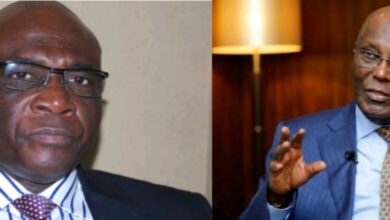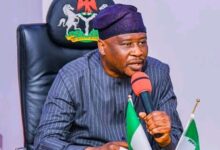

Political economist, Prof. Pat Utomi, has backed the position of the Catholic Bishops’ Conference of Nigeria (CBCN) on the state of the nation, accusing the ruling All Progressives Congress (APC) of shrinking Nigeria’s democratic space and undermining the free exchange of ideas.
Utomi made the remarks in a series of posts on X (formerly Twitter) on Sunday, following comments by the Archbishop Emeritus of the Catholic Archdiocese of Abuja, John Cardinal Onaiyekan, who disclosed that President Bola Tinubu disagreed with the bishops’ assessment of the economy and security during their recent meeting at the Presidential Villa, Abuja.
Declaring his support for the Catholic bishops, he wrote: “On the democratic space and extant reality in Nigeria I stand with John Cardinal Onaiyekan and the Catholic Bishops. Those who think shrinking the space for competition of thought either do not understand the essence of democracy, or are mischievous.”
The former presidential candidate argued that democracy thrives on open competition of ideas, citing German philosopher Jürgen Habermas’ concept of the public sphere.
He stressed that rational public discourse and a vibrant marketplace of ideas are essential to democratic governance, alleging that the APC had worked to frustrate such engagement.
Utomi also accused the ruling party of prioritising political survival over democratic principles, alleging that it had encouraged political defections and weakened ideological opposition. He claimed the development had widened the disconnect between the political class and ordinary Nigerians.
Referencing the works of political scientist Claude Ake, he asserted that post-colonial African states often prioritise their own survival over the welfare of their citizens, adding that Nigeria’s current political environment reflects that pattern and has contributed to stalled national progress.
He equally alleged that the APC had weakened key democratic institutions by capturing the legislature and the judiciary while encouraging attacks against dissenting voices on social media instead of engaging in constructive debate.
“The APC’s fear of competing ideas is evident in the incorporation of the judiciary, capture of the legislature and unleashing of miscreants on social media to insult those they are incapable of engaging in rational public conversation,” he stated.
Utomi criticised the controversy surrounding the idea of a shadow government, describing the reaction by government supporters as evidence of intolerance toward alternative political viewpoints. He argued that the concept of a shadow cabinet has long been recognised in parliamentary democracies such as the United Kingdom and should not be treated as unconstitutional.
Reflecting on his decades-long involvement in Nigeria’s pro-democracy movement, Utomi recalled that his commitment to nation-building began as a university undergraduate during the struggle against military rule, adding that he had closely followed global scholarship on the challenges facing democratic systems.
He referenced the books How Democracies Die by Steven Levitsky and Daniel Ziblatt and How Democracy Ends by David Runciman, saying they echoed concerns similar to those he expressed in his own book, Why Not.
Utomi further warned against the growing use of propaganda and identity politics, saying they had deepened divisions among Nigerians along ethnic, religious, and political lines.
According to him, the increasing “us versus them” mentality has damaged relationships and undermined national cohesion, describing it as one of the most harmful consequences of the country’s current political climate.
He also lamented what he described as the rise of “predatory opportunism” in contemporary Yoruba politics, emphasising that the actions of what he called the “complicit middle” had enabled democratic decline by remaining silent in the face of moral and political challenges.
He urged Nigerians to resist divisive politics and defend democratic values, maintaining that meaningful nation-building requires tolerance of differing opinions, robust public debate, and institutions capable of holding those in power accountable.