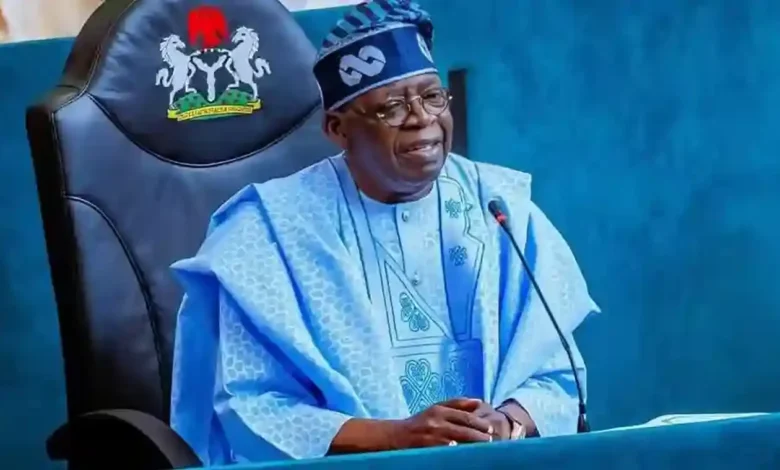
President Bola Tinubu has declared that Nigeria has moved past a difficult economic period, saying the country has now entered a new phase in which prosperity and improved living standards must become the focus.
Tinubu asserted that the reforms introduced by his administration had confronted longstanding weaknesses in the Nigerian economy rather than creating them, insisting that the government would not reverse course.
The President stated this on Thursday, October 1, 2026, in his Independence Day address to Nigerians as the country marked its 66th anniversary of independence.
The address, themed “Reforms to Prosperity,” focused largely on the government’s economic reforms, the state of the economy, and its plans to reduce the cost of living, create jobs, and achieve what he described as shared and widespread prosperity.
Tinubu recalled that Nigeria’s journey since independence had been marked by war, military rule, economic crises, insecurity, and political upheaval, but the country had continued to endure because of the resilience and determination of its people.
He noted that the promise of independence went beyond the attainment of sovereignty, stressing that it was also about giving Nigerians the freedom and opportunity to shape their destiny and build a nation capable of providing dignity and a better life for its citizens.
The President acknowledged that the country had faced serious economic challenges, saying previous governments had postponed difficult decisions and allowed deep economic distortions to persist.
“By 2023, poverty was rising, and hope was nearly gone. The country’s situation was darker than ever. We had no choice but to act,” he said.
Using the analogy of a patient suffering from cancer, the President described the reforms as painful but necessary treatment for longstanding economic problems.
He stated that Nigeria had for too long relied on measures that merely eased the symptoms of its economic problems without addressing their underlying causes.
“When this administration assumed office, we resolved to do things differently. We chose to excise the cancer. The reforms that followed were difficult. The side effects were real. Yet, we must never confuse the medicine with the disease,” he stated.
Tinubu argued that the reforms had begun to produce improvements in the economy, citing growth, lower inflation, improved foreign reserves, greater stability in the foreign exchange market, and increased non-oil exports.
He mentioned that the economy had grown by more than four per cent in 2026, with both the oil and non-oil sectors contributing to the growth.
He also claimed that oil theft had declined, inflation had fallen from its peak, and foreign reserves had been rebuilt.
According to him, Nigeria recorded more than $6 billion in non-oil export revenue in 2025, which he described as the highest in the country’s history.
The developments, he said, showed that Nigeria had reached a turning point and that the government’s economic priorities were now shifting from correcting the country’s economic direction to delivering broader prosperity.
“My fellow Nigerians, we have reached a turning point. The emergency treatment is over. The foundation has been repaired. The central economic task before us has changed,” he said.
“Now, our purpose is simple: shared and widespread prosperity.”
The President disclosed that the next phase of his administration’s economic agenda would focus on reducing the cost of living by lowering the cost of producing and transporting goods.
He listed increased agricultural production, mechanised irrigation, dry-season farming, access to seeds and fertiliser, mechanisation, storage and transportation among the areas the government would prioritise.
Tinubu also revealed that the government was investing in roads, railways, and ports to improve the movement of goods between farms, factories, and markets.
He said that lower transportation costs would ultimately help reduce the prices of goods and improve the purchasing power of Nigerians.
The President also placed job creation and industrial growth at the centre of the next phase of his administration’s policies.
He stated that the government would deploy Nigeria’s gas resources to support new industries, help revive factories in major industrial centres, expand digital connectivity, and invest in skills needed by employers.
“I want to see more Nigerians making things. I want to see more Nigerian farms feeding our cities and supplying our factories. I want to see Nigerian businesses selling Nigerian goods to the whole world,” Tinubu said.
He also expressed his desire to see young Nigerians build globally competitive businesses and create employment opportunities within the country.
However, the President acknowledged that millions of Nigerians were still struggling with the cost of food, education, healthcare, and transportation.
He noted that their difficulties predated the reforms of his administration and were the result of decades of low productivity, inadequate infrastructure, limited opportunities, and institutional weaknesses.
“We cannot erase in four years what accumulated over generations. But we can change its course.”
Tinubu mentioned that his administration would therefore continue to strengthen social protection programmes to support vulnerable Nigerians while pursuing policies aimed at creating sustainable economic opportunities.
He cited the strengthening of direct support for poorer households and improvements to the National Social Register as part of the government’s efforts to ensure that assistance reaches those who need it.
The President also highlighted the Nigerian Education Loan Fund (NELFUND), saying it would help students from low-income families access higher education, while CREDICORP would provide working Nigerians with access to consumer credit for assets such as vehicles, solar systems, and digital devices.
He further promised continued investment in primary healthcare, basic education, and other essential public services in collaboration with state and local governments.
He pointed out that his administration had also maintained the payment of salaries and pensions and undertaken reforms aimed at benefiting retirees and vulnerable Nigerians.
He stressed, however, that social programmes were not intended to replace economic prosperity.
“These programmes are not substitutes for prosperity. They are a bridge to aid our nation’s citizens on their path towards it. Our objective is not to manage poverty more efficiently. We will defeat it,” he assured.
Tinubu acknowledged that eliminating poverty would take time and require sustained economic growth as well as the creation of millions of productive opportunities.
He maintained that the country was now approaching the challenge from a stronger economic position.
“The age of reform has done its work. Now begins the age of prosperity,” he declared.
The President urged Nigerians to look forward rather than dwell on the difficulties of the past, saying the sacrifices made during the reform period would ultimately yield results.
“Nigeria has corrected its course. We have passed through our own Red Sea. This is not the time to look back.”
Tinubu described the Nigeria he envisaged as a country of abundance and opportunity, where prosperity would be broadly shared and children would be able to aspire beyond the circumstances of their birth.
“Our destination is in sight. Our foundations are strong. Our direction is clear. So let us go forward. No looking back,” he remarked.
He further wished Nigerians a happy Independence Day and prayed for the continued progress and wellbeing of the Federal Republic of Nigeria.