Why Port Regulation is Critical to Nigeria’s Fisheries, Blue Economy Growth — NPERA DG Akutah


The Director-General/Chief Executive Officer of the Nigerian Ports Economic Regulatory Agency (NPERA), Dr. Pius Akutah, has said transparent and predictable port economic regulation is critical to reducing logistics costs, attracting investment and unlocking the potential of Nigeria’s fisheries and wider blue economy.
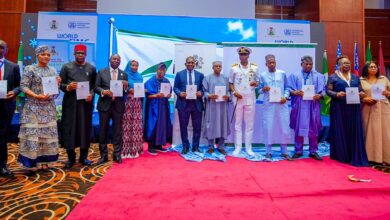
Akutah spoke at the Maritime Correspondents Organisation of Nigeria (MARCON), National Conference on Sustainable Fishing held at Apapa with the theme, “Sustainable Fishing in Nigeria: Pathways to Growth, Food Security and Coastal Livelihoods.”
He said the fisheries value chain cannot be strengthened by increasing fish production alone, stressing that efficient infrastructure, logistics and a predictable business environment are equally necessary to move fish from landing sites to consumers and export markets.
Speaking on “Port Economic Regulation as a Catalyst for Sustainable Fishing and Blue Economy Development in Nigeria,” he said Nigeria’s maritime economy extends beyond shipping and cargo handling to fisheries, aquaculture, coastal commerce, marine services, logistics and tourism.
Akutah, who was represented by Mr. Waheed Olagunju, Deputy Director, Standards Services, noted that although many artisanal fishers do not operate through major seaports, the wider port and maritime logistics system remains important to the sector, as fishing vessels and equipment often depend on imported components, while processors require machinery, packaging and refrigeration equipment. Seafood exporters, he added, also depend on efficient cargo handling, documentation and transportation.
Akutah said high input costs, inadequate cold-chain infrastructure, post-harvest losses, illegal, unreported and unregulated fishing, limited access to finance and governance challenges continue to constrain the sector.
He said: “The central proposition is that transparent, predictable, evidence-based and coordinated economic regulation can reduce friction throughout the fisheries value chain, promote investment and trade, improve food security and strengthen coastal livelihoods.”
According to him, excessive or unclear charges, weak service standards, fragmented procedures and avoidable delays could have the opposite effect by raising costs and weakening the competitiveness of Nigerian fish products.
Akutah explained that port economic regulation is not limited to tariffs, but covers service standards, competition, market access, commercial conduct and dispute resolution.
Under the Port Economic Regulations 2015, he said, the regulatory framework includes tariff guidelines, monitoring of service standards, protection of competition, prevention of abuse of dominant market positions, dispute resolution, promotion of efficiency, reduction of the cost of doing business, encouragement of private-sector investment and monitoring of concession agreements.
He said the transition in 2026 from the Nigerian Shippers’ Council’s former economic-regulatory role to NPERA presents an opportunity to strengthen the framework.
While NPERA is responsible for areas including tariffs and charges, licensing, service standards, fair competition, commercial dispute resolution, trade facilitation and protection of port users, Akutah noted that the Nigerian Ports Authority retains responsibility for port infrastructure and landlord functions.
The NPERA boss said the price of fish is influenced by far more than harvesting, with fuel, vessel maintenance, landing, ice, storage, transportation, inspection, documentation and port services all adding to the final cost.
He advocated transparent tariffs, publication of approved charges, monitoring of billing practices and effective dispute-resolution mechanisms to reduce unnecessary costs and disputes.
Akutah also stressed the need for measurable service standards because fish is highly perishable. Delays in inspection, documentation, cargo release and transportation, he said, could result in spoilage and reduced product quality.
He identified documentation turnaround, inspection coordination, reefer handling, power availability, gate operations and complaint resolution as areas where measurable standards should be established.

Deputy Director, Standards Services, NPERA
He further called for a regulatory environment capable of attracting investment in cold storage, ice plants, reefer facilities and temperature-controlled transportation, which he said are essential to reducing post-harvest losses.
Beyond infrastructure, Akutah said regulation must promote fair access to essential services, prevent discriminatory practices and address abuse of dominant market positions while preserving incentives for private investment and better service delivery.
On seafood exports and regional trade, Akutah said efficient documentation, certification, inspection, cargo handling and Customs procedures are essential.
He advocated interoperability among port, Customs, maritime, fisheries, health and other government systems to eliminate repetitive submissions and accelerate cargo clearance, citing the International Maritime Organization’s Maritime Single Window framework as an important reference.
He said port regulation can support the blue economy through five key principles: efficiency, predictability, inclusion, accountability and sustainability.
These, he explained, would help reduce the time and cost of moving fisheries products, give fishers, processors, exporters and investors greater certainty, include small businesses and artisanal enterprises in regulatory processes, improve accountability through published charges and performance data, and ensure that trade facilitation does not aid the movement of illegally harvested fish.
Akutah identified transparent tariffs, measurable service standards, digital interoperability, a fisheries logistics window, cold-chain connectivity, inter-agency coordination and green, climate-resilient ports as key regulatory priorities.
He proposed a fisheries logistics window that could provide standardised documentation and inspection procedures, priority processing where justified and escalation mechanisms for time-sensitive fisheries and temperature-controlled cargo.
He also called for logistics planning that connects coastal landing sites and production areas to processing centres, cold stores, inland waterways, roads, rail, ports, airports and markets.
According to him, NPERA should work with maritime, fisheries, Customs, environmental, standards and state authorities to coordinate responsibilities, data and problem-solving.
He also advocated energy-efficient cold storage, renewable energy, improved waste management, cleaner cargo-handling equipment and emissions-reduction measures as part of port and concession standards.
Akutah said the success of fisheries reforms should not be measured by fish production alone, but by their impact on food availability and affordability, employment, income generation and environmental sustainability.
He stressed that port reforms must also benefit small-scale and artisanal operators who may not directly use major seaports but depend on affordable ice, fuel, equipment, transportation, finance and market access.
He therefore called for major port reforms to be linked with improvements at coastal landing sites, cooperative development, access to finance, skills development and market-information systems.
Among the policy measures proposed were a whole-value-chain approach to port regulation; transparent, evidence-based and consultative tariff-setting; accelerated interoperability among maritime, port, Customs and fisheries digital systems; and a national fisheries logistics and cold-chain investment plan linking production and landing areas with processors, markets and ports.
He also recommended stronger traceability and risk-based controls against illegal fishing, concession and licensing arrangements to encourage investment in cold-chain, digital and green infrastructure, as well as a public dashboard of selected port-performance indicators covering trade facilitation, service quality and fisheries logistics while protecting commercially sensitive information.
Akutah said Nigeria’s blue-economy ambition would ultimately depend not only on its marine resources but also on its ability to build institutions and infrastructure that allow those resources to generate value efficiently, inclusively and sustainably.
He said the success of the new NPERA framework should be reflected in fewer avoidable delays, transparent charges, improved service quality, stronger cold-chain investment, better market access, reduced waste and greater value retained by legitimate businesses and coastal communities.
He summed up the strategic link between the two sectors, saying: “Sustainable fishing requires sustainable logistics, and sustainable logistics requires sound economic regulation.”
He added that aligning port regulation with fisheries sustainability, digital trade facilitation, investment promotion and coastal livelihood objectives could transform Nigerian ports from mere cargo gateways into enabling infrastructure for food security, trade, jobs and a resilient blue economy.