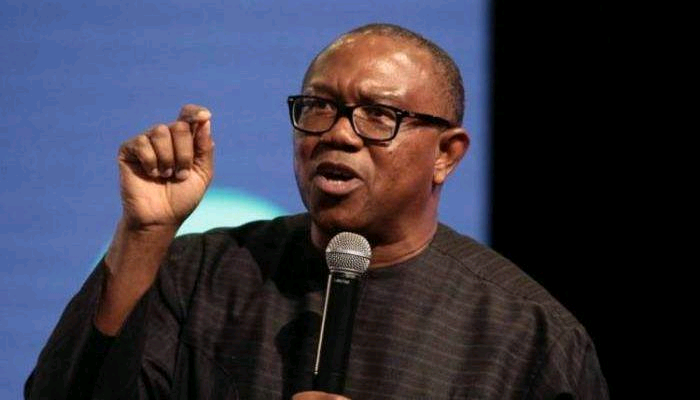
The presidential candidate of the Nigeria Democratic Congress (NDC), Peter Obi, has criticised the Federal Government’s 30-day petrol discount, describing the policy as “plain political optics masked as policy” and questioning its ability to address the economic hardship faced by Nigerians.
Reacting to the policy in a statement on Sunday, Obi described the temporary discount as another example of what he called the reactive and confused approach to governance under President Bola Tinubu.
He disclosed that he had delayed his response to the announcement to assess its outcome before concluding that the policy substituted political optics for sound policymaking.
Recalling the removal of petrol subsidy by Tinubu on May 29, 2023, Obi faulted the government for implementing the policy without adequate consultation or proper assessment of its potential impact on the economy and the livelihood of ordinary Nigerians.
He also criticised the subsequent floating of the naira and tax reforms, arguing that the policies were poorly sequenced and implemented in a disorganised manner.
The former Anambra State governor further faulted the simultaneous use of three budgets, which he said raised concerns about transparency and accountability.
Obi pointed out that the combined effects of these policies have contributed to inflation, rising costs of goods and services, increasing poverty, unemployment, business closures, insecurity, and widening inequality.
He argued that rather than conduct and publish detailed regulatory impact assessments of its policies, the Tinubu administration had continued to introduce measures without adequately engaging stakeholders and ordinary Nigerians.
Obi maintained that a competent approach to governance would involve consultations and transparent assessments to develop inclusive and sustainable strategies for socioeconomic growth.
Questioning the purpose of the 30-day petrol discount, he asked whether a reduction of less than five per cent in fuel costs could meaningfully address poverty, unemployment, insecurity, and inequality or improve productivity and exports.
“Is it a test to ascertain if subsidy should be restored? Is it another political gambit in the face of threats of electoral loss in the 2027 election?” he asked.
Obi also questioned the accessibility of the discount, which the Federal Government said would be available at NNPC Retail petrol stations, with priority given to public transport operators.
He noted that Nigeria had an estimated 24,000 petrol stations, compared with about 900 NNPC Retail stations, meaning that fewer than four per cent of the country’s petrol stations would offer the discount.
Using an estimated population of 243 million, Obi explained that the arrangement translated to approximately 243,000 Nigerians per NNPC Retail station, assuming an even distribution of the stations across the country.
He argued that the actual distribution was not even and questioned how such an arrangement could provide meaningful relief to the population.
“Imagine 243,000 Nigerians struggling for a ₦66.00 per litre discount in each of the NNPC petrol stations,” he said.
While promising to provide a more detailed explanation of his position on fuel subsidy and a policy roadmap for fair, transparent, and affordable petroleum pricing, Obi revealed that research on Nigeria’s current revenue and revenue potential under what he described as an incorrupt, transparent, and competent government supported his position that subsidy should be restored.
He emphasised that such subsidies should extend beyond petrol to agriculture, health, education, and infrastructure.
Obi asserted that Nigeria needed leadership focused on policies capable of reducing the cost of living through welfare-enhancing pricing policies and their honest administration.
“It is clear that President Tinubu’s October 1 policy announcement is neither of that. It is plain political optics masked as policy. Nigerians are tired of those gimmicks. It is time for real change,” he added.