
The Nigeria Customs Service (NCS) and Benin Customs are moving to transform the Sèmè–Kraké Joint Border Post into a technology-driven and fully integrated facility, with emphasis on Customs interconnectivity, joint risk management, coordinated enforcement, secure infrastructure, harmonised procedures and accountable governance.
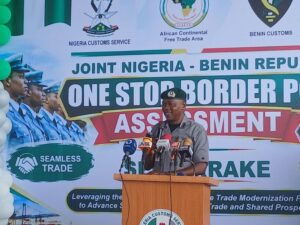
The Comptroller-General of Customs, Bashir Adewale Adeniyi, disclosed this at Seme border on Friday, during the joint Nigeria-Benin Republic one stop border post assessment tagged: “Leveraging the Nigeria Customs Service Trade Modernisation Project To Advance Seamless Cross-Border Trade and Shared Prosperity”.
According to him, the facility must be approached as a strategic border modernisation programme, rather than a collection of isolated repairs.
“What we seek to achieve here is that Sèmè–Kraké be treated as a strategic border modernisation programme, and not as a series of isolated repairs,” he said.
Adeniyi said the existing facility already has key physical infrastructure, including lanes, parking areas, offices, a weighbridge and scanner housing, but noted that the two Customs administrations are yet to operate through a fully integrated system.
“Without interconnectivity, this is not a joint border post. It is two border posts sharing a car park,” Adeniyi said.
He explained that the NCS is working with Benin Customs on a common data exchange arrangement that would enable declarations lodged on one side of the border to be visible to the other in real time.
The arrangement, he added, would support the tracking of transit cargo from origin to destination while ensuring that risk profiles and enforcement alerts generated by either administration reach its counterpart when they remain operationally useful.
Adeniyi said the transformation would also involve restoring scanning capability, strengthening access control, surveillance and lighting, and establishing a standing Nigeria-Benin enforcement and intelligence mechanism.
He called for harmonised bilingual standard operating procedures covering cargo, passengers, inspection, transit and incident escalation, as well as a joint risk management framework and an empowered management structure for shared infrastructure.
The NCS boss also announced the launch of a dedicated facility to address the needs of women traders operating along the corridor, with simplified procedures for small consignments, information in languages spoken by traders, accessible points of contact and a channel for reporting poor treatment.
He said the initiative is designed to bring more women traders into the formal system while reducing harassment, extortion and delays at the border.
According to him, the measures form part of the broader objective of making the Sèmè–Kraké crossing more efficient, transparent and responsive to legitimate trade.

Also speaking, the Directeur Général of Benin Customs, Col. Raouf Malehhossou Aboudou, expressed support for the NCS’ efforts to recalibrate operations at the Seme-Krake border to facilitate trans-border trade.
Aboudou commended the CGC for what he described as pragmatism and purposefulness in reinventing operational systems to improve cross-border commerce.
He assured that the Benin Customs administration would vigorously support the initiative, adding that its officers and personnel are ready to work with their Nigerian counterparts to achieve its objectives.
On his part, the Seme Customs Area Controller, Comptroller Abdullahi Shuaibu Kaila, expressed the command’s commitment to supporting measures aimed at enhancing seamless trade between Nigeria and Benin Republic.
Kaila, in his welcome address, commended the CGC and his Benin Republic counterpart for their commitment to taking trade along the Seme-Krake corridor to a new level of renewed energy and vitality.
He said the commitment of both Customs administrations is critical to improving operations at the strategic crossing, which plays a significant role in Nigeria’s trade relationship with Benin Republic and the wider West African market.
The renewed framework places on the Seme Command the responsibility of facilitating legitimate trade while maintaining border security, protecting government revenue and enforcing applicable restrictions.