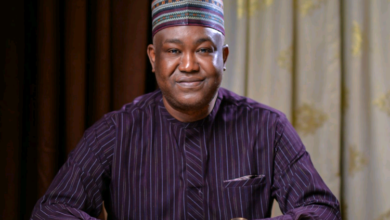

The Deputy Spokesperson of the House of Representatives, Philip Agbese, has rejected claims that the 10th National Assembly is a “rubber stamp” legislature, saying the House has demonstrated independence by pursuing its own legislative agenda and rejecting proposals it considered unsuitable.
Agbese stated this on Monday during an interview on Channels Television’s Politics Today, while responding to criticisms that the National Assembly routinely approves proposals presented by the executive without adequate scrutiny.
He asserted that the perception that the 10th Assembly was a rubber stamp was partly rooted in “ignorance” and the negative perception inherited from previous relationships between the legislature and the Nigerian people.
Agbese explained that the House, which came into office in June 2023, immediately established a legislative agenda outlining its priorities and how it intended to conduct its affairs.
“We are neither rubber nor stamp,” he said, stressing that the House had taken steps to make its activities more accessible to Nigerians and strengthen its oversight functions.
He noted that the House had expanded its committee structure to 138 committees to improve oversight of government agencies and institutions, while the offices of the spokesperson and deputy spokesperson had been strengthened to provide information to the public.
Agbese also dismissed suggestions that the House hurriedly adopted the executive’s proposal on state police, saying the legislature had been considering the issue before the executive formally took it up.
He emphasised that the House had conducted deliberations and consultations across the country as part of its constitutional amendment process, with state police among the issues under consideration.
“We have a parliament that is actually ahead of the executive. Before the executive came up with the issue of state police, we had a series of deliberations on state police,” he stated.
Agbese added that the consultations had enabled the House to obtain what he described as a consensus from Nigerians, which accounted for the speed with which the proposal was considered.
On claims that lawmakers lacked independence from the executive, he disclosed that the House had rejected proposals that did not align with its priorities.
He cited the rejection of a budgetary provision for the purchase of a yacht for the Nigerian Navy in 2023 as an example of the legislature exercising its independent judgment.
“We said no to it,” he remarked.
The lawmaker, who is also a member of the House Committee on Defence, further claimed that the legislature had proposed an increase in the salaries and emoluments of military personnel before the Federal Government approved the recent pay rise.
According to him, the House had engaged members of the Armed Forces, including the Chief of Defence Staff, during its deliberations on the welfare and remuneration of military personnel.
He revealed that the current Minister of Defence, when he was Chief of Defence Staff, had made a presentation to the House, following which the legislature included improved salaries and emoluments for service personnel in its proposals to the executive.
Agbese said that the President’s approval of the salary increase reflected a proposal that had already been advanced by the House.
“What the President has done is just to key into what we have proposed in the House.”
He maintained that the legislature had consistently scrutinised budget proposals and made adjustments where necessary, particularly in areas considered important to national development and security.
On the treatment of Nigerians in South Africa, Agbese opposed calls for a harsher response, saying diplomatic engagement remained the appropriate approach.
He affirmed that the diplomatic efforts undertaken so far were producing positive results, citing his recent engagement with South Africans during a visit to Johannesburg and subsequent efforts to promote peaceful relations between both countries.
Agbese explained that the objective should be to strengthen relations between Nigerians and South Africans and promote peace across the continent rather than escalate tensions.
He also noted that migration from Nigeria to other countries was not always driven by economic hardship, arguing that some Nigerians relocate for reasons including marriage and family ties.
The lawmaker maintained that the National Assembly remained committed to exercising its constitutional responsibilities while working with the executive in areas of common national interest.