The United States has commended the National Drug Law Enforcement Agency (NDLEA) for its operational successes, particularly the dismantling of four methamphetamine laboratories linked to Mexican cartels in Nigeria this year.
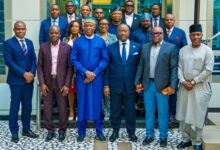
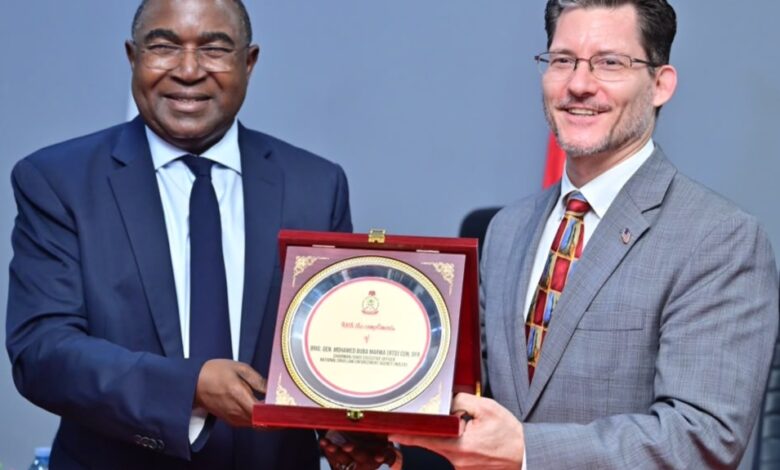
The commendation came from the United States Deputy Assistant Secretary of State for International Narcotics and Law Enforcement Affairs (INL) for Africa and the Middle East, Michael Gonzales, during a visit to the NDLEA National Headquarters in Abuja on Tuesday, October 20, 2026.
Gonzales, who was received by the Chairman/Chief Executive of NDLEA, Brig. Gen. Mohamed Buba Marwa (rtd), and members of the Agency’s management team, described Nigeria as the clear choice for his first official visit since assuming office four months ago.
He stated that Nigeria’s position as a continental leader and economic powerhouse, coupled with the NDLEA’s leadership, operational achievements, and longstanding partnership with INL, informed his decision to visit the country.
“I wanted to see firsthand where the magic happens, as we say in the United States,” he said.
Gonzales cited the four methamphetamine laboratory busts recorded by the Agency this year as evidence of its effective deployment of intelligence-led investigations, inter-agency and cross-border coordination, operational excellence, interrogation, investigation, and prosecution.
He stressed that narcotics trafficking was an international challenge with far-reaching consequences for both countries, noting that counter-narcotics operations directly protect communities in Nigeria and the United States.
“The reality of the narcotics trade is one that is international. It knows no boundaries, very few constraints,” he said, adding that the work of INL and NDLEA “fundamentally delivers for the Nigerian people, for the American people.”
The US official noted that more than four decades of INL partnerships with countries worldwide had involved training and equipment donations, including support for Nigeria.
He also warned that intensified pressure on drug cartels in the Western Hemisphere could redirect trafficking flows towards Africa and onward to Europe and Oceania. He called for sustained action against transnational criminal organisations, including the financial networks that facilitate their operations.
In his response, Marwa described the partnership between INL, the US Drug Enforcement Administration (DEA), and NDLEA as a shared investment in the collective security of both countries.
He warned that Mexican cartels were making deliberate efforts to establish Nigeria as a methamphetamine manufacturing hub, with the intention of using West Africa as a corridor for trafficking illicit drugs to international markets.
“The Mexican cartel threat is real, and we are confronting it,” Marwa remarked.
He disclosed that NDLEA operatives had dismantled what he described as the largest clandestine methamphetamine laboratory ever discovered in Nigeria, located in a forest in Ijebu East, Ogun State, where three Mexican methamphetamine experts and their Nigerian collaborators were arrested.
According to him, illicit substances worth more than $360 million were recovered during the operation.
Marwa added that barely four weeks later, the Agency raided another industrial-scale laboratory at Tapa Village in neighbouring Oyo State, arresting a Mexican methamphetamine expert and four Nigerian collaborators. Similar facilities were subsequently dismantled in Enugu and Ebonyi States, in the South-East.
He emphasised that the discoveries indicated an attempt by the cartels to establish an industrial-scale production base in Nigeria for onward distribution to international markets.
“These cartels are not setting up in our forests to supply Nigerian consumers alone. They want a West African corridor to ship industrial quantities of methamphetamine to Europe, to Asia, and to American cities.”
Marwa warned that the cartels’ search for alternative trafficking routes made Nigeria’s enforcement operations critical to the security of the United States, particularly amid intensified efforts to disrupt drug flows into America.
“Every meth-producing laboratory that we shut down is a supply line that never reaches an American street, and every cartel operative we arrest is one fewer in the pipeline,” he stated.
The NDLEA boss further highlighted the connection between drug trafficking, illicit arms, and terrorism, warning that proceeds from the drug trade sustain armed groups and facilitate terrorist activities across borders.
“Crime has no borders, and neither does the threat. The drugs we seize, the arms we intercept and the terrorist financing we trace are not separate problems.”
He added that threats emanating from the Sahel and the Lake Chad Basin extended beyond the region, while trafficking routes through West Africa could have consequences far beyond Nigeria’s coastline.
Marwa affirmed that INL assistance had strengthened the Agency’s capacity in forensic and chemical analysis, professional training, investigative and financial-crime skills, and equipment maintenance.
He disclosed that the partnership had contributed to the arrest of 96,157 drug offenders, including 250 drug barons, the seizure of more than 15.8 million kilogrammes of assorted illicit drugs and the conviction of 16,691 drug traffickers, including kingpins, in the last five years.

He warned that any withdrawal of INL support could create gaps that criminal networks and terrorist groups might exploit. He also urged the US government to sustain or increase its assistance to the Agency.
Marwa asked Gonzales to convey the message to Washington that INL support “as is, should be maintained if not increased.”
He maintained that governments must strengthen cross-border cooperation to effectively confront the threats posed by traffickers, arms dealers, and terrorist groups.