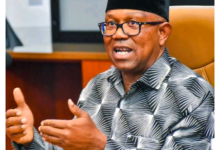

Former Anambra State Governor, Peter Obi, has detailed how his administration promoted commerce, industrial development, and job creation through infrastructure investments, public-private partnerships, support for indigenous businesses, and access to development financing.
Obi, who served as governor from 2006 to 2014, said that his administration adopted a deliberate strategy under the Anambra Integrated Development Strategy (ANIDS) to harness the state’s entrepreneurial potential, attract investments, strengthen local industries, and expand employment opportunities.
He explained that his administration recognised the need to move beyond traditional commercial activities towards manufacturing, processing, and value addition, stressing that sustainable economic development required infrastructure and institutional support capable of enabling businesses to thrive.
Highlighting efforts to modernise commercial activities in the eighth instalment of his series on his administration’s interventions in Anambra, Obi said that his administration initiated the First and Second Onitsha Business Parks to provide organised, modern, and secure business environments for corporate operations, financial institutions, and other businesses.
He added that the second phase of the Onitsha Business Village was conceived as a centre for information and communications technology-related activities, while the LG World-ANIDS project was designed as a one-stop centre for electronic goods, services, and training.
In the hospitality sector, Obi stated that the Agulu Lake Resort was conceived to harness the tourism potential of Agulu Lake, stimulate economic activities in surrounding communities, and create employment.
He also highlighted the proposed five-star Protea Hotel project in Onitsha, conceived through a public-private partnership to provide quality accommodation for investors, business travellers, and tourists, although the project was subsequently abandoned.
The presidential candidate of the Nigeria Democratic Congress (NDC) also disclosed that his administration initiated plans for modern shopping malls in Awka, Onitsha, and Nnewi to complement traditional commerce, attract local and international businesses, and expand employment opportunities. He noted that the Onitsha mall was wholly privately sponsored after the state provided the necessary infrastructure.
On industrial development, Obi mentioned that his administration actively engaged indigenous manufacturers, including Innoson Vehicle Manufacturing, Chikason Industries, Orange Drugs Industries, Cutix Cable, Krisoral Group, Juhel Pharmaceuticals, Neimeth and Ekulo Group.
He emphasised that the government supported local industries through patronage, infrastructure development, and efforts to improve access to finance and commercial networks.
Obi recalled personally visiting Innoson Vehicle Manufacturing in Nnewi and inspecting its operations with the company’s founder, Chief Innocent Chukwuma. He added that the state government also patronised the company through the purchase of vehicles.
He further revealed that his administration produced an Industrial Master Plan for Anambra State to provide strategic direction for industrial development, identify investment opportunities, and establish a framework for expanding the state’s productive capacity.
On access to finance, the former governor affirmed that his administration established partnerships with the Bank of Industry (BOI) and the Bank of Agriculture (BOA) to provide affordable credit to entrepreneurs, manufacturers, and farmers.
He recalled personally approaching the then Managing Director of BOI, Mrs. Evelyn Oputu, to initiate a partnership between the bank and Anambra State. According to him, the engagement led to the establishment of the bank’s presence in the state, for which his administration secured an office and paid the initial two years’ rent.
The partnership culminated in the Anambra State Government-Bank of Industry MSME Fund, under which the state committed ₦500 million as its contribution to a 50:50 counterpart funding arrangement with the bank. The facility was designed to provide equipment and working capital financing to micro, small, and medium-scale enterprises.
In agriculture, Obi disclosed that his administration, in collaboration with the Bank of Agriculture, launched a ₦1.2 billion revolving loan facility in December 2013. The first phase was designed to benefit 960 farmers and 192 small and medium-scale enterprises and agro-businesses.
He also recalled facilitating a ₦1 billion agricultural credit facility in 2012 through the Commercial Agriculture Credit Scheme and announcing arrangements in January 2014 for an additional ₦1.5 billion in loans to farmers, with part of the funding sourced from the Bank of Agriculture.
Obi explained that the initiatives were intended to increase agricultural production, support businesses along the agricultural value chain, and improve farmers’ access to the capital required to expand their operations.
Regarding infrastructure, he noted that his administration prioritised roads serving important industrial locations, including Cutix Cable in Nnewi, Innoson Vehicle Manufacturing, and the Harbour Industrial Estate in Onitsha.
He listed Krisoral Group, Ekulo Group, Dozzy Group, Brollo Pipe and Profile Ltd, Orange Drugs and SABMiller Breweries, among the industrial concerns operating within the Harbour Industrial Estate, stressing that functional access roads were essential for transporting raw materials and finished products.
Obi also identified the establishment of the SABMiller brewery in Onitsha through Intafact Beverages as a major example of his administration’s investment attraction efforts.
He said that the project involved an investment of approximately $100 million and was commissioned on August 30, 2012, with the Anambra State Government holding a 10 per cent equity interest.
Obi stated that the investment created employment, stimulated demand for distribution and other services, and strengthened economic activities around the industrial facility. The brewery was subsequently expanded.
He further disclosed that his administration engaged prospective investors, including Distell, Neimeth International Pharmaceuticals and GlaxoSmithKline, to establish or expand their operations in Anambra. He said that he personally participated in investment promotion engagements in South Africa to present the state’s commercial advantages and opportunities in manufacturing, agriculture, and other sectors.
However, Obi regretted that some of the companies involved in those engagements subsequently left the state after his administration.
Ahead of the 2027 election, the presidential candidate stressed that his experience reinforced his conviction that Nigeria must build a strong productive economy by strengthening industries, supporting entrepreneurs, and creating an environment that encourages businesses to remain, expand, and employ more Nigerians.
He called for the modernisation and expansion of the country’s ports, improved cargo handling and clearance procedures, and better road, rail, and electricity infrastructure connecting ports and industrial centres to markets.
Obi also advocated policies that would address multiple taxation, policy inconsistency, insecurity, and bureaucratic obstacles capable of discouraging investment.
As part of his proposed national economic agenda, he pledged that, if elected President, he would ensure that specialised development finance institutions, particularly the Bank of Industry and the Bank of Agriculture, dedicate at least 20 per cent of their lending portfolios to small and medium-sized enterprises.
He maintained that SMEs deserved deliberate financial support because of their importance to employment, enterprise, and economic growth.
Obi invited journalists, researchers, business associations, industrialists, and citizens to independently examine the projects and initiatives undertaken during his administration.
He specifically urged Nigerians to visit the Onitsha Business Parks, Harbour Industrial Estate, and indigenous manufacturing facilities, as well as investigate the SABMiller investment, the Agulu Lake Resort, Protea Hotel project, shopping mall initiatives, and the various financing arrangements with BOI and BOA.
He also encouraged the public to examine the Industrial Master Plan and establish the status of investment agreements and projects pursued under his administration before it left office in March 2014.
Obi argued that the record of any administration should be established through independently verifiable evidence rather than its own claims.
He added that Nigeria’s sustainable prosperity depended on transforming the country from an economy driven largely by consumption into one that manufactures, creates, innovates, and exports.
He further stated that in the next instalment of the series, he would examine his administration’s achievements in sports development, including investments in sporting infrastructure, support for athletes, and initiatives to promote sporting excellence in Anambra State.