The Secretary General of the Maritime Organisation of West and Central Africa (MOWCA), Dr Paul Adalikwu, has pledged to deepen efforts to promote Blue Economy awareness and investment opportunities across Africa, particularly in Nigeria’s Niger Delta region.
Adalikwu said the region’s vast waterways, coastline and strategic access to the Gulf of Guinea offer significant opportunities in maritime transport, fishing, tourism, underwater mining, renewable energy and other ocean-based activities beyond its traditional dependence on oil and gas.
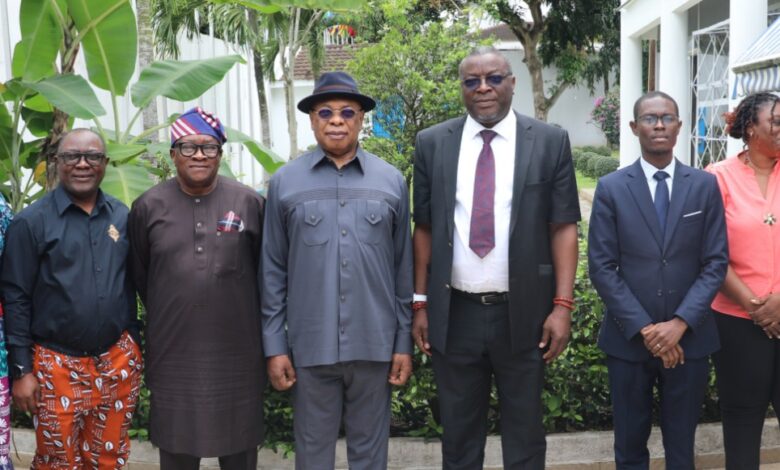
He stated this when he received a high-level delegation from the Niger Delta Chambers of Commerce, Industry, Trade, Mines and Agriculture (NDCCITMA) at the MOWCA Secretariat in Abidjan, Côte d’Ivoire, on Thursday.
The delegation, led by the NDCCITMA Board Secretary, Chief Dr Solomon Edebiri, and accompanied by Development Partner, Arc. Tonye Braide, was in Abidjan to follow up on an earlier invitation extended to the MOWCA Secretary General to attend the inaugural Niger Delta Economic and Investment Summit and Exhibition (NDEIS 2026) as Special Guest and Keynote Speaker.
Adalikwu described the natural marine endowments of the Niger Delta and other parts of Africa as a divine blessing that could only be harnessed through strategic and sustainable policies, investments and practices.
According to him, the Niger Delta, in addition to its vast oil and gas resources, holds enormous prospects for development through maritime transport, fishing, tourism, underwater mining and other profitable ventures.
He said strategic and sustainable public-private partnerships could position the region to attract greater foreign direct investment, create jobs and accelerate economic development.
The MOWCA chief stressed the need to leverage the Niger Delta’s waterways, coastal location and access to the Gulf of Guinea to build an integrated platform for investment, trade and job creation.
He added that MOWCA is interested in initiatives that advance regional maritime cooperation, Blue Economy development, infrastructure, renewable energy and sustainable growth across West and Central Africa.
The NDCCITMA delegation said the three-day NDEIS 2026 is scheduled for September 15–17, 2026, at the Obi Wali International Conference Centre, Port Harcourt, Rivers State, in partnership with the Niger Delta Development Commission (NDDC), with the theme, “Driving Investment, Innovation, and Industrial Growth in the Niger Delta.”
According to the delegation, NDEIS 2026 is designed as a practical investment platform rather than a talk-shop, with deal rooms, business-to-business and business-to-government engagements, sectoral forums, investment matchmaking, exhibitions and direct interactions with development partners.
The objective, they said, is to convert the region’s natural and economic potentials into bankable projects.
While the Niger Delta is traditionally associated with oil and gas, the Chambers highlighted opportunities in agriculture and agro-processing, compressed natural gas, industrial development, logistics, warehousing, packaging, export production, renewable energy and maritime activities.
Through its Economic Development Initiative, NDCCITMA said it had supported more than 4,000 micro, small and medium enterprises with structured financing in less than a year.
A significant part of the meeting focused on the Blue Economy, with the delegation highlighting the Niger Delta’s extensive coastline, waterways, ports, fishing resources and strategic position on the Gulf of Guinea as assets capable of driving employment, trade and industrial growth if properly developed.
The delegation expressed interest in attracting international technical cooperation, investment and partnerships to help move the region beyond heavy dependence on hydrocarbons towards sustainable ocean-based activities, fisheries, aquaculture, marine transport and coastal infrastructure.
Potential areas of collaboration identified during the meeting included Blue Economy projects, maritime infrastructure, renewable energy, investment mobilisation, regional cooperation within the Gulf of Guinea, technical capacity building, maritime trade and logistics, and linkages with international development partners.
Both sides noted the strong alignment between the objectives of NDEIS 2026 and MOWCA’s mandate to promote maritime transport, safety, infrastructure, trade facilitation and sustainable development of the maritime sector.
They agreed that the Niger Delta’s strategic location could position it as a hub for regional maritime trade, logistics, energy and Blue Economy activities capable of benefiting countries across the Gulf of Guinea.
The working visit was described as productive, with MOWCA expressing willingness to continue its engagement with NDCCITMA and other Nigerian stakeholders to explore practical ways of advancing the maritime and economic development of the Niger Delta.