The Nigeria Customs Service (NCS) is strengthening its use of data, intelligence and technology to anticipate trade risks, target high-risk consignments and facilitate legitimate cargo movement with minimal disruption.
The approach is designed to enable Customs to make faster and more informed decisions by combining risk profiling, data analytics, automation, artificial intelligence and intelligence-led interventions in the management of international trade.
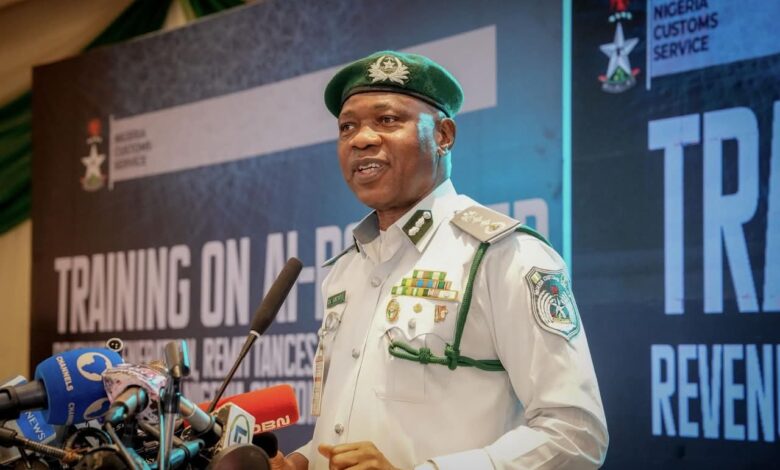
The Comptroller-General of Customs, Dr. Bashir Adewale Adeniyi, made the disclosure at the 2026 Maritime Training Summit of the Association of Maritime Journalists of Nigeria (AMJON) in Lagos on Friday.
According to Adeniyi, the objective is to ensure that Customs officers focus their expertise on transactions that require intervention while compliant trade benefits from faster and more predictable clearance.
“The question confronting Customs administrations globally is no longer: ‘How do we inspect more cargo?’ Rather, the question should be: ‘How do we identify the right cargo for intervention while allowing compliant trade to move with minimum interruption?’”
The Customs boss, who was represented by the National Public Relations Officer, Deputy Comptroller, Abdullahi Maiwada, PhD, said risk management, data analytics, automation and intelligence provide the basis for achieving that objective, allowing Customs to distinguish between legitimate, compliant transactions and those presenting potential risks.
He stated that the Service is building greater capacity to use information generated across the trading process to identify unusual patterns, detect possible fraud and support targeted enforcement.
Adeniyi said every Customs declaration, vessel arrival, container movement, valuation decision, inspection, seizure and cargo release generated data which, when properly integrated, could provide a powerful picture of international trade.
The challenge, he said, was no longer simply collecting such information but turning it into actionable intelligence.
He said Customs should be able to determine what commodities were entering Nigeria, who was importing them, where they originated, the values declared, the routes used and the patterns that could indicate fraud or other risks.
This data-driven approach is being supported by the B’Odogwu Unified Customs Management System, the NCS’s indigenous digital Customs platform designed to strengthen cargo processing, risk management, valuation, revenue accounting, compliance management, data analytics and information exchange.
Adeniyi described the platform as more than a technology project, saying it represented a shift towards integrated and data-driven Customs administration.
He said the National Single Window (NSW), which entered its first phase in March 2026, would further strengthen this approach by enabling relevant government agencies to share information through an integrated digital environment.
According to him, interoperability among government and private-sector systems would improve risk analysis, speed up decisions, reduce unnecessary intervention and lower the cost of international trade.
Artificial intelligence, he added, would increasingly strengthen Customs’ capacity to process the enormous volumes of information generated by modern commerce.
He identified potential applications of AI in risk profiling, anomaly detection, cargo targeting, valuation analysis, detection of unusual trading patterns, fraud identification, predictive enforcement, document verification and intelligence development.
The CG said the combination of AI, data analytics and intelligence would move Customs closer to a predictive model in which potential risks could be identified before cargo arrives and enforcement officers provided with actionable intelligence ahead of an intervention.
He said non-intrusive inspection technology would complement the system by allowing targeted cargo to be examined through advanced scanning and imaging without unnecessarily disrupting legitimate supply chains.
Combined with risk profiling and intelligence, he said, the approach would allow Customs to identify, target and examine consignments based on assessed risk, while physical intervention would be applied where necessary.
On the fight against smuggling, Adeniyi said criminal networks were increasingly exploiting legitimate supply chains, false documentation, complex ownership structures, digital communication and sophisticated concealment techniques.
He said the NCS was responding with intelligence-led and technology-supported enforcement, combining risk management, surveillance, data analysis, inter-agency cooperation and targeted interventions.
“The objective is not enforcement for its own sake. The objective is to create an environment where legitimate businesses can thrive, compliant traders can move faster, and illicit actors face increasing difficulty.”
He said the ultimate ambition was to develop a Customs environment capable of anticipating emerging risks rather than simply responding to events after they occurred.
“Not merely: ‘What happened?’ But: ‘What is likely to happen, and what should we do about it?’”
Adeniyi said achieving this ambition would require deeper integration of B’Odogwu, the National Single Window and other relevant systems, alongside continued investment in data infrastructure, analytics, artificial intelligence and predictive risk management.
He also identified public-private collaboration and the institutionalisation of innovation as priorities for sustaining the transformation.
Beyond technology, the CG stressed the importance of developing personnel capable of operating effectively within the emerging digital Customs environment.
He said Customs officers would increasingly require expertise in data analytics, artificial intelligence, cybersecurity, digital trade, risk management, supply-chain security, international trade agreements and emerging technologies.
He also urged maritime stakeholders, including customs brokers, shipping companies, terminal operators and journalists, to continuously improve their understanding of the digital trading environment.
Turning to collaboration, Adeniyi said the complexity of modern trade makes it necessary for Customs to work closely with the Nigerian Ports Authority, Nigerian Maritime Administration and Safety Agency, regulatory agencies, shipping lines, terminal operators, freight forwarders, banks, technology providers and other stakeholders.
The CG, however, warned that increased digital connectivity also came with greater cybersecurity responsibilities, stressing the need for strong authentication, data protection, secure information exchange, system redundancy, business continuity arrangements and regular security assessments.
He said the NCS’s transformation is aimed at building a better Customs administration.
“The destination is a Customs administration that is faster, smarter, more transparent, more secure, more predictable and more professional.”
He said the Service’s success remains inseparable from that of Nigeria’s maritime and trading ecosystem, adding that innovation should ultimately serve as an instrument for national prosperity by facilitating legitimate trade while protecting the country’s economic interests.