Following the success of its maritime security architecture known as the Deep Blue project, the Nigerian Maritime Administration and Safety Agency (NIMASA) says it is considering an expansion of the project which impact has been felt across the Gulf of Guinea and gained global recognition, to ensure sustainability and greater impact.
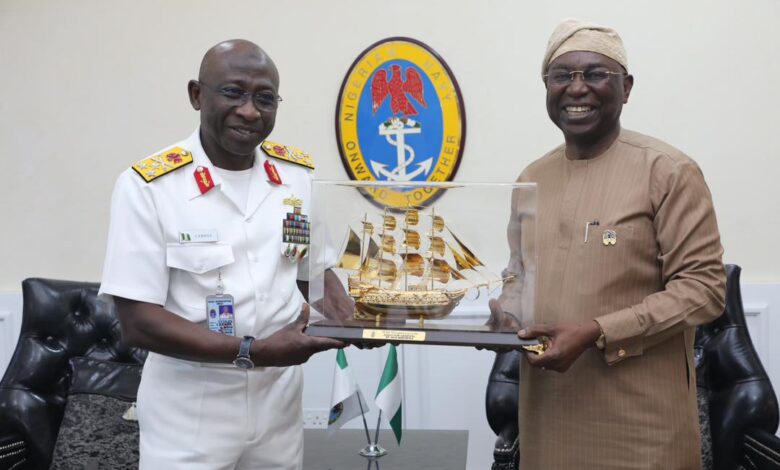
Director General of NIMASA, Dr. Dayo Mobereola, made this known during his strategic visit to the Chief of Naval Staff, Vice Admiral Idi Abass, at the Naval Headquarters, Abuja, on Thursday.
Mobereola, while commending the Navy for their harmonious collaboration with NIMASA and congratulating the CNS who had perviously served as Maritime Guard Commander under the Agency, called for continued partnership with the Navy under his watch.
“It is important that we continue our partnership and strenghten our relationship. Our purpose here is to congratulate you, and to discuss the benefits of the Deep Blue Project; how to sustain it, expand it, and increase its impact on the Gulf of Guinea.
“We are confident that we have the backing of the President, the Minister of Marine and Blue Economy, and the Nigerian Navy, hence, we are working towards presenting our proposal on the necessary improvements to be undertaken,” he stated.
The DG acknowledged the importance of the Deep Blue Project, noting that its impact resonates globally, with the International Maritime Organisation (IMO) commending it.
“The Deep Blue Project is vital and countries around Africa and some other parts of the world are coming to copy our model. The IMO is asking how a civilian organisation was able to achieve this feat. It is therefore important that we continue to collaborate and do even better for greater sustainability,” he said.
Mobereola also congratulated the Chief of Operations, Nigerian Navy, Rear Admiral Musa Katagum, who is joining the NIMASA governing Board as the Navy’s representative.
On his part, the Chief of Naval Staff, Vice Admiral Idi Abass commended the Agency for the good work it is doing in the maritime sector and its continued support to the Nigerian Navy.
He said: “Part of my command’s objective is to work in synergy with other agencies to achieve our goal as a country. We complement each other. We have no option rather than collaborate and synergise.”
Abass noted some concerns which include the MoU between NIMASA and the Nigerian Navy which has been in place since 2007 and should be revisited.
He also solicited for the Navy to be called upon for such needs as vessel repair, hydrographic surveys and chartings, stating the Navy’s capacity in handling such tasks.
The CNS also canvassed NIMASA’s assistance for wreck removal, particularly as the Navy gears towards its 70th Anniversary where it looks forward to welcoming foreign ships.
He further commended NIMASA for its recent launch of the Cabotage Vessel Financing Fund (CVFF) Application Portal, noting that the Agency has come a long way in its planned disbursement of the fund.