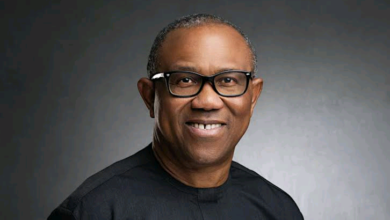
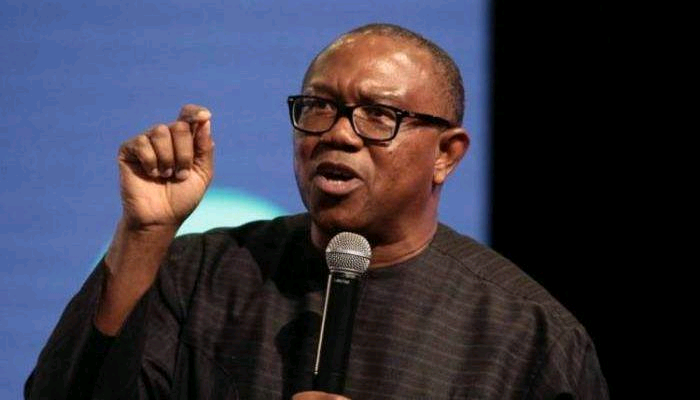
Presidential aspirant under the Nigeria Democratic Congress (NDC), Peter Obi, has said that Nigeria is not a poor country but is being looted into poverty.
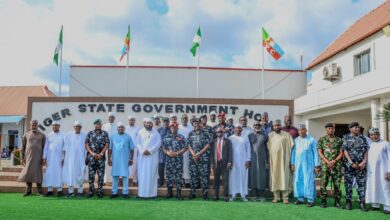
Speaking at the NDC National Convention in Abuja on Saturday, Obi stated that Nigeria has enormous human and natural resources to stay afloat.
He referenced Winston Churchill, saying: “Some men change their party for the sake of their principles; others change their principles for the sake of their party.”
Obi expressed gratitude to the NDC leadership, led by Senator Henry Seriake Dickson, for accommodating recent defectors, and to the African Democratic Congress (ADC), particularly Senator David Mark, for providing a democratic platform and showing uncommon understanding “when the ongoing litigation forced us out of the Labour Party and the New Nigeria People’s Party (NNPP), respectively.”
His words: “That spirit of solidarity must remain the foundation upon which a better Nigeria will be built. Today, the most painful aspect of our political existence is that many who once benefited from democratic governance have now become willing accessories to the destruction of democracy itself.
“Those who once fought for justice now openly celebrate electoral injustice. Those who once spoke against impunity now defend coercion, manipulation, intimidation, and outright political gangsterism, especially against opposition voices. What we are witnessing is not politics; it is a systematic assault on democracy and the will of the people.”
He noted that Nigeria is currently at a dangerous crossroads, asserting that its democracy is under severe threat. According to him, Nigeria is drifting without direction, and its people are passing through immense suffering.
“Across the world, Nigeria is increasingly described as a failing and disgraced nation. This is not the destiny God ordained for our great country. It was not always so, and it must never be allowed to remain so.
“Across virtually every recognised indicator of good governance – accountability, political stability, rule of law, control of corruption, government effectiveness, regulatory quality, and the separation of powers – Nigeria continues to record alarming failures,” he said.
Obi decried that the institutions that should protect the people are weakening daily, while the burden on ordinary citizens grows heavier with each passing moment.
He also noted that over 140 million Nigerians currently live in multidimensional poverty, pointing out that tens of millions of young people remain unemployed or underemployed.
He lamented that inflation continues to crush families, businesses are shutting down, and that farmers can no longer safely access their farms. “Communities live in fear. In this month alone, hundreds of innocent Nigerians have lost their lives to insecurity, while many others have been kidnapped, displaced, or thrown deeper into poverty.”
“The most heartbreaking question confronting us is this: Who consoles the grieving mother whose child was abducted on the way to school? Who speaks for the father who can no longer feed his family despite working every day? Who defends the young Nigerian whose dreams have been destroyed by a nation that rewards connections over competence and corruption over character?” Obi asked.
He equally argued that Nigeria’s present tragedy is not accidental, describing it as a direct consequence of years of deliberate sabotage by a political class that prospers by dividing the people and weakening the nation.
“Nigeria is not a poor country; rather, we are being looted into poverty. We have abundant human and natural resources, yet we remain trapped in deprivation because leadership has failed to place the common good above personal interest.”
He stressed that Nigerians have a clear choice — whether to surrender to despair and national decline, or to summon the courage to rescue the country and rebuild it on the foundations of unity, equity, justice, competence, and productivity.
The former Anambra State governor emphasised that, at this point, national unity is no longer optional but a national necessity, while urging Nigerians to rise above ethnicity, religion, region, and political divisions to recover the soul of the country.
Obi further argued that, with unity and effective leadership, Nigeria can become a productive and prosperous nation once again.
“We must deliberately support agriculture and manufacturing so they become the highest contributors to our Gross Domestic Product. Special strategic attention must be given to unlocking the enormous agricultural potential of Northern Nigeria and connecting it to industrial production across the federation. We must move decisively from a nation of consumption to a nation of production. We can no longer afford policies that foreclose our youth,” he remarked.
He expressed confidence that, with competent, compassionate, and transformative leadership, Nigeria can defeat insecurity, reduce corruption, create jobs, tame inflation, improve education, and restore hope to millions of Nigerians.
Obi maintained that youths must no longer be viewed as problems to manage, but as assets to empower. He also disclosed that women must no longer be neglected, but included as equal partners in nation-building.
He expressed conviction that a Nigeria that is united, secure, productive, inclusive, and governed by justice and fairness is realistic.
“Let us therefore move forward with courage, with unity, and with our collective resolve,” he added.