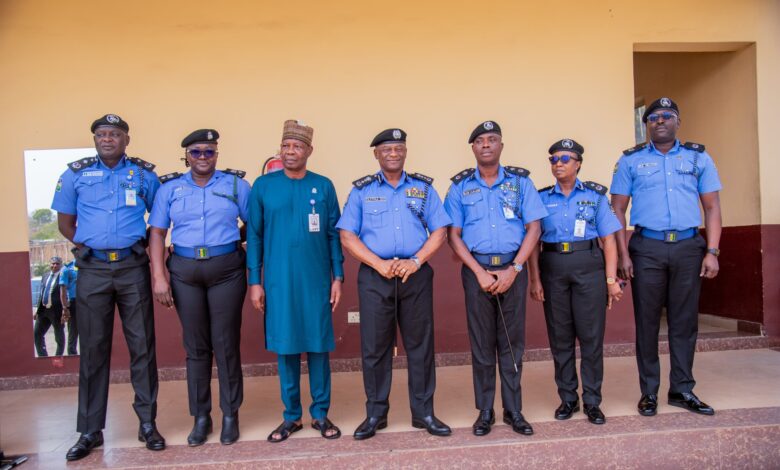
The Inspector-General of Police, Olatunji Disu, has formally inaugurated a Steering Committee on the Establishment of State Police, describing the initiative as a significant and timely step towards strengthening Nigeria’s internal security architecture.
Speaking at the inauguration ceremony, the IGP said the task before the committee was both “significant and timely”, as it reflects the nation’s collective determination to make policing more responsive to the realities of local communities.
He noted that Nigeria continues to confront evolving security challenges that demand innovative thinking, strategic collaboration and a willingness to explore reforms that will enhance the protection of lives and property.
According to him, the concept of State Police is being carefully examined as part of broader national efforts to improve security governance, bring policing closer to the people and deepen community participation in crime prevention.
The IGP charged members of the committee to carry out their assignment with professionalism and objectivity, stressing that their work would help shape a framework through which State Policing may operate in a manner that strengthens, rather than fragments, the national security system.
Among other responsibilities, the committee is expected to review existing policing models within and outside Nigeria; assess community security needs and emerging risks across the country; propose an operational framework for the establishment and coordination of State Police structures; address issues relating to recruitment, training, standards and resource allocation; and develop robust accountability and oversight mechanisms to ensure professionalism and public trust.
The police chief said that if thoughtfully designed and effectively implemented, State Policing holds significant potential benefits for the country. He explained that bringing law enforcement closer to communities would deepen local knowledge of security dynamics and enable quicker and more targeted responses to emerging threats.
He added that such a system could strengthen public confidence in law enforcement by fostering closer relationships between officers and the communities they serve, noting that enhanced familiarity with local cultures, languages and social structures would improve intelligence gathering and cooperation.
On resource management, the IGP said decentralisation of certain policing responsibilities could allow for more efficient allocation of security resources, with state governments and local authorities better positioned to address specific security challenges within their jurisdictions, while the Federal Government focuses on broader national security priorities.
He also highlighted the potential economic and social benefits of the reform, stating that the establishment of State Police structures would create employment opportunities for thousands of young Nigerians, contributing to national development while boosting security capacity.
The IGP, however, emphasised that State Policing should not be seen as a replacement for, or a diminution of, the Nigeria Police Force. Rather, he described it as a complementary structure within a coordinated national security framework.
He reiterated that the Nigeria Police Force would continue to play its constitutional role as the primary national law enforcement institution responsible for maintaining internal security across the federation.
According to him, the introduction of State Police is expected to enhance overall policing efficiency by allowing the Federal Police to concentrate more strategically on complex and transnational crimes such as terrorism, organised crime, cybercrime and trafficking networks that require national coordination and specialised capabilities.
He assured officers and men of the Force that their relevance and responsibilities within Nigeria’s security architecture remain intact and indispensable, stressing that the vision behind the reform is one of synergy and partnership, not competition or duplication.
On the composition of the committee, Prof. Olu Ogunsakin, Director-General of the National Institute for Police Studies, Jabi, Abuja, will serve as Chairman, while CP Bode OJajuni is Secretary.
Other members are DCP Okebechi Agora, DCP Suleyman Gulma, ACP Ikechukwu Okafor, CSP Tolulope Ipinmisho and CP Emmanuel Ojukwu (Rtd), Provost, Police Public Relations School.
The IGP urged members of the committee to approach their assignment with diligence, intellectual rigour and patriotism, noting that their recommendations would guide policymakers in shaping a policing framework that safeguards democratic values, upholds the rule of law and ensures accountability.